Ten years ago, California voters overwhelmingly supported Proposition 57, rejecting the harshest features of the state’s criminal justice system. After decades of overcrowded prisons and poor reentry outcomes, Proposition 57 promised a new path. It sought to boost education and rehabilitation programming in prisons, expand access to prisons’ “good conduct” credits, and allow more youth to receive rehabilitative support in the juvenile system, rather than be tried as adults.
Did Proposition 57 accomplish all that it promised? This report summarizes a decade of available data on Proposition 57’s youth and adult justice system impacts.
Introduction
Treating youth as youth
Proposition 57 eliminated the most punitive practice in California’s juvenile justice system at the time: direct file. Under direct file, which was established in 2000 through Proposition 21, prosecutors could file charges in adult criminal court against youth as young as 14 years old with no review by a judge. This led to thousands of youth being tried as adults, with many sentenced to decades or even life in prison.
Direct file placed enormous decision-making authority in the hands of prosecutors, with little recourse for young people or their defense attorneys. Moreover, it relegated youth to a system that prioritized punishment over rehabilitation, failing to acknowledge their capacity for growth and change.
2016’s Proposition 57 did not eliminate the practice of trying youth as adults — it simply installed a safeguard. Youth could not be placed into the adult criminal justice system unless a transfer was approved by a juvenile court judge. Judges were required to consider several factors, including the youth’s potential for rehabilitation and the severity of their crime.
Prior to Proposition 57, hundreds of youth were sent to adult court each year, with data showing distinct racial and geographic disparities (Ridolfi, Washburn, & Guzman, 2016).
Figure 1. Disparity in the rates of direct file, 2014
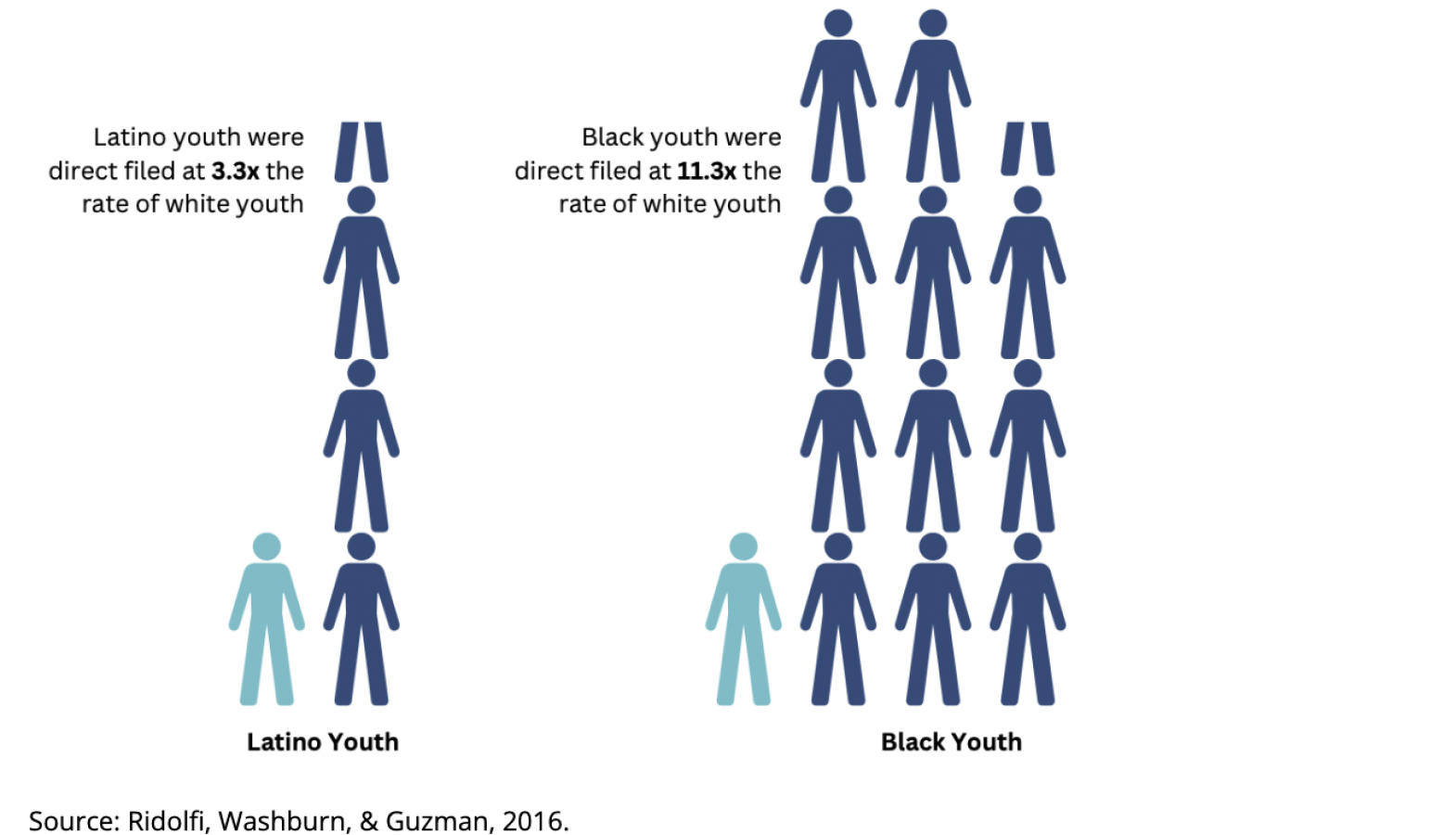
The harm of direct file fell hardest on Black and Latino youth. In 2014, for every white youth sent to adult court via direct file, 3.3 Latino youth and 11.3 Black youth were directly filed (Figure 1). That same year, 13 counties, including Alameda, Fresno, Los Angeles, and Monterey, directly filed only Black and Latino youth.
Direct file also exacerbated geographic disparities, creating an uneven system of juvenile justice. In some counties, nearly all youth facing serious felony charges remained in the juvenile system or received the benefit of judicial review, yet in others, direct file was the norm, denying youth an opportunity to demonstrate their rehabilitative potential. For example, in 2014, Yuba County prosecutors directly filed 54% of all youth with serious felony arrests, compared to less than one percent in Los Angeles County.
Figure 2. California youth tried in adult court, 2007 – 2025
Since Proposition 57’s passage, the number of youth tried as adults has fallen by nearly 80% (Figure 2). The decline reflects two factors. First, falling numbers of youth tried as adults accompanied plummeting rates of youth involvement in serious violent crime. Rates of youth arrested for murder, rape, robbery, and aggravated assault have fallen 63% since 2007, and more modest arrest declines since 2015 (-15%) have continued to shrink the pool of potential transfer cases (Figure 3).
Figure 3. Youth violent felony arrest rate per 100,000 youth ages 10 – 17, 1990 – 2025
Secondly, drops in adult court transfers coincided with both Proposition 57 (2016) and Senate Bill 1391 (SB 1391, 2018), another significant legal change that barred youth under 16 from being tried in adult court. Together, these reforms recognized that the juvenile justice system was better equipped to meet young people’s needs, ensuring that, for the small number of youth arrested each year for serious offenses, most could receive the benefits of the juvenile justice system.
Several years later, another juvenile justice reform built on the foundation of Proposition 57 and SB 1391. Senate Bill 823 (SB 823, 2020) closed the state’s youth prisons and replaced them with more robust local alternatives called Secure Youth Treatment Facilities (SYTFs). With this change, juvenile courts were granted extended jurisdiction over youth accused of serious crimes, allowing young people with serious needs to remain in secure local facilities well into their 20s. This change may have bolstered judges’ confidence in the rehabilitative opportunities available in the juvenile justice system, which, in turn, reduced their likelihood of transferring young people to the adult system. The data supports this. The share of transfer hearings resulting in adult court placement has declined since the passage of Prop 57: 62% of hearings resulted in transfer in 2017, the first year of Proposition 57’s implementation, compared to just 21% in 2024 (Figure 4).
Figure 4. Share of transfer hearings that resulted in a youth transferred to adult court, 2007 – 2025
Taken together, these reforms have brought the number of youth subjected to the adult criminal justice system to under 100 per year, with even fewer youth ultimately convicted in criminal court. In 2025, just 34 young people were sentenced to prison for a crime committed before they turned 18, roughly one-tenth of the number sentenced in 2007.
Spurring rehabilitation
In addition to its critical reform of the juvenile justice system, Proposition 57 sought to curb dangerous and unconstitutional overcrowding in state prisons. It addressed this crisis by, first, offering parole opportunities to those imprisoned for nonviolent offenses who had already completed their base terms and, second, expanding credit-earning for those who participated in prison programming or exhibited good conduct. Proponents hoped that these reforms would prepare imprisoned Californians for safe and productive lives in their communities, while easing intensive court oversight of the state’s prisons.
The data show that Proposition 57 succeeded in both lessening prison overcrowding and lowering recidivism rates, especially for those who took advantage of in-prison rehabilitative and educational offerings.
The prison population decline came quickly, falling more than 20% in the years since Proposition 57’s passage. This decline, which followed two other major population reductions (2011’s Public Safety Realignment and 2014’s Proposition 47), has been a defense against indiscriminate court-ordered releases and saved the state hundreds of millions of dollars in correctional spending. In 2015, the year before Proposition 57 took effect, CDCR’s institutional population was 136.3% of its design capacity or just one thousand people short of the court-ordered population cap of 137.5% (Senate Budget Sub 5, 2015). Even a small surge in prison admissions would have put the state at risk of violating the court order. As of fall 2026, CDCR’s institutional population was just 123.7% of design capacity, approximately 10,000 people below the cap, a durable reduction that has allowed for the closure of multiple state prisons, camps, and living units (CDCR, 2026).1
Proposition 57 helped achieve these reductions through opportunities for parole, not automatic releases. People convicted of nonviolent offenses become eligible for review by the Board of Parole Hearings once they have served the full term of their primary offense. However, the Board has shown a reluctance to grant many Proposition 57 releases. Since July 2017, CDCR has made 43,931 referrals of determinately sentenced people to the Board for review. Of the 39,695 cases decided on the merits, the Board approved 5,159 (13%) and denied 34,536 (CDCR, 2026a). In other words, most parole reviews end in denial, either due to factors in an individual’s case, their in-prison record, or the parole board’s well-established bias against release (Garcia, 2026).
While several thousand people have been released under nonviolent parole, many more have earned early parole consideration through Proposition 57 credit-earning (CDCR, 2026b). The initiative extended good behavior, milestone, educational, and rehabilitation credits, at varying rates, to nearly everyone in state prison. These credits have accelerated release timelines for tens of thousands of imprisoned Californians.
Some individuals have already reentered their communities due to accelerated parole consideration, and their outcomes are encouraging. The three-year reconviction rate for people released in Fiscal Year 2020 – 21 was substantially lower for those who participated in prison programming (Figure 5). Of those released with no credits, 45.6% were convicted for a new offense within three years of release compared to 23.2% among those who earned educational credits and 18.5% among those who earned rehabilitative credits in prison. Most strikingly, recidivism rates were just 3% for those who earned both educational and rehabilitative credits (CDCR, 2026c).
Figure 5. Three-year conviction rate by credit-earning status for those released in Fiscal Year 2019 – 2020
Conclusion
Proposition 57 has achieved its core goal of safely reducing California’s prison population and all but ending the transfer of youth into adult criminal courts. This reform, which was widely embraced by voters in 2016, has been further bolstered by dramatic declines in crime and arrests for both youth and adults. These promising trends, which have endured through a pandemic, periods of pronounced economic uncertainty, and numerous subsequent changes in the law, have helped concentrate public resources into communities where they can be used to prevent serious crime before it occurs.
References
California Department of Corrections and Rehabilitation (CDCR). (2026). Weekly Report of Population As of Midnight September 23, 2026. At: https://www.cdcr.ca.gov/resear….
California Department of Corrections and Rehabilitation (CDCR). (2026a). Three‑Judge Court Quarterly Update. At: https://www.cdcr.ca.gov/3‑judg….
California Department of Corrections and Rehabilitation (CDCR). (2026b). In-Prison Credit-Earning Opportunities. At: https://www.cdcr.ca.gov/propos….
California Department of Corrections and Rehabilitation (CDCR). (2026c). Statewide Recidivism Report for Individuals Released From the California Department of Corrections and Rehabilitation in Fiscal Year 2020 – 21. At: https://www.cdcr.ca.gov/resear….
California Department of Justice (DOJ). (2026). Juvenile Justice in California, 2007 – 2025. At: https://oag.ca.gov/cjsc/pubs#j….
Garcia, J. (2026). Many California prisoners get a second chance. A declining parole rate shows that’s no guarantee. CalMatters. At: https://calmatters.org/justice….
Proposition 57. (2016). Criminal Sentences. Parole. Juvenile Criminal Proceedings And Sentencing. Initiative Constitutional Amendment and Statute. At: https://vigarchive.sos.ca.gov/….
Ridolfi, Washburn, & Guzman. (2016). The Prosecution of Youth as Adults: A County-level Analysis of Prosecutorial Direct File in California and its Disparate Impact on Youth of Color. At: https://www.cjcj.org/media/import/documents/the_prosecution_of_youth_as_adults.pdf.
Senate Bill 823 (SB 823). (2020). Juvenile justice realignment: Office of Youth and Community Restoration. At: https://leginfo.legislature.ca….
Senate Bill 1391 (SB 1391). (2018). Juveniles: fitness for juvenile court. At: https://leginfo.legislature.ca….
Senate Subcommittee 5 on Corrections, Public Safety, Judiciary, Labor and Transportation (Senate Budget Sub 5). (2016). Agenda. At: https://sbud.senate.ca.gov/sit….
Senate Subcommittee 5 on Corrections, Public Safety, Judiciary, Labor and Transportation (Senate Budget Sub 5). (2026). Agenda. At: https://sbud.senate.ca.gov/sys….