This is CJCJ’s second report in our California Juvenile Justice Realignment Series. Report author Daniel Macallair is CJCJ’s Executive Director. He is also the Practitioner-in-Residence and Lecturer with the Department of Criminal Justice Studies at San Francisco State University
Executive Summary
The closure of the California Department of Corrections and Rehabilitation’s Division of Juvenile (DJJ), formally the California Youth Authority (CYA), ended a system that had failed youth, families, and communities for over a century. In its place, California instituted a policy of juvenile justice realignment where responsibility for formerly state committed youth was transferred to the state’s 58 counties. For most youth, this means community supervision, diversion programs, and local services. For a smaller population adjudicated for serious and violent offenses, it means commitment to county juvenile halls operating as secure facilities.
This is the policy case for getting that secure track right. Realignment creates the opportunity to do something fundamentally better than the DJJ. However, the single greatest risk of realignment is that California’s counties will replicate the dysfunction of violence, the gang subcultures, the staff misconduct other failures that made the state system indefensible on a smaller scale, closer to home, and with less public scrutiny.
California’s own documented institutional history makes the policy stakes clear. The Commonweal Research Institute’s investigations of the 1980s, the Farrell v. Allen litigation of 2003, CJCJ’s numerous monitoring reports, and decades of recidivism data all tell the same story: large congregate institutions that concentrate serious youth offenders do not rehabilitate them. They generate the violence-producing subcultures, the family severance, the educational disruption, and the criminal network deepening that produce worse outcomes.
County-based secure care has structural advantages such as smaller populations, proximity to families and communities, shorter confinement periods, and local accountability. Those advantages will produce better outcomes only if counties make five deliberate policy choices:
Five Imperatives for County Secure Care
- Prevent violent institutional subcultures through small living units, appropriate staffing ratios, and therapeutic programming
- Prevent staff abuse and neglect through values-based hiring, trauma-informed training, use-of-force restrictions, and independent complaint mechanisms
- Organize secure facilities around reintegration as the defining mission not incapacitation
- Build genuine partnerships with locally rooted Community Based Organizations — not corporate service providers
- Establish independent accountability systems with real data, real inspections, and real consequences
This report makes the case for each of these imperatives, grounded in California’s own correctional history and in CJCJ research on what effective county-based secure care requires. A companion soon to be released report, The Secure Track: The Implementation Framework, addresses how counties should operate existing facilities to meet. these standards. No new construction is required or appropriate. California currently has 9,113 juvenile hall beds operating at barely 31 percent of capacity, with 6,252 beds sitting empty (BSCC, 2026, 2026a). The challenge is not building more — it is using what exists sparingly, correctly, and only for the most serious offenders.
Historical Context: CYA, The DJJ, & Realignment
California’s state youth correctional system was created with rehabilitative intent and sustained by institutional inertia long after the evidence of its failure became incontrovertible. Understanding that history is not an exercise in retrospection, it is the foundation for understanding what county-based secure care must avoid.
Origins of the California Youth Authority
California’s state-run youth correctional institutions have their origins in the late 19th century and the Whittier State School (later Fred C. Nelles Youth Correctional Facility) and the Preston School of Industry, both established in the 1890s. These facilities were built on the reformatory model: the then-progressive idea that youthful offenders could be rehabilitated through discipline, work, and education in a structured residential setting removed from the corrupting influences of urban life. Within a generation the reformatory model had produced the same results as the prisons it was meant to replace: violence, abuse, racial segregation, and recidivism rates that undermined every rehabilitative claim.
The California Youth Authority (CYA) was established in 1941 not to replace the state’s reform schools but to rationalize and professionalize their management. The new agency consolidated control over the existing reformatories Whittier, Preston and the institutions that followed under a single administrative structure. Its founding philosophy promised a renaissance in institution-based rehabilitation: classify youth by individual need, provide differentiated treatment, and return them to their communities transformed. The institutions, under more sophisticated management, would finally deliver what the reformatory movement had always promised.
From CYA to DJJ: Documented Failure
In its final decade as the DJJ, the agency was beset by conditions its own leadership acknowledged it could not address. The Commonweal Research Institute had documented those conditions systematically since the 1980s. The first Commonweal report, Conditions of Life in the California Youth Authority (1982), described dormitories housing dozens of youth in large rectangular rooms under the surveillance of a single guard station. The second, Bodily Harm (1986), described conditions the Youth Authority’s own director could not dispute.
“The tragedy of the Youth Authority today is that a young man convicted of a crime cannot pay his debt to society safely. The hard truth is that CYA staff cannot protect its inmates from being beaten, from being sexually assaulted, or even from being killed.”
The Farrell v. Allen lawsuit, filed in 2003 by taxpayer Margaret Farrell and represented by the Prison Law Office, Disability Rights Advocates, and co-counsel, confirmed what the Commonweal reports had documented twenty years earlier. Youth were denied access to mental health services even when diagnosable conditions were on file. Reports of sexual assault were routinely mishandled or inadequately investigated.
Forced use of psychotropic medications was documented. A consent decree followed, driving the DJJ’s eventual closure. The DJJ’s recidivism record matched its conditions. Youth released from state facilities returned to communities years later educationally disadvantaged, family connections severed, and with a criminal network that had deepened during their confinement.
“These institutions — long criticized for their failure to rehabilitate, their disproportionate impact on youth of color, and their high costs — have been substantially downsized or closed. Their closure reflected decades of research demonstrating that institutional confinement is harmful, disrupts education and family ties, and does not produce lasting reductions in delinquent behavior.”
The Case for Closure and Realignment
SB 823 (2020) mandated the transfer of DJJ-eligible youth to county jurisdiction, effective July 1, 2021, bringing an end to a 132-year-old system. The legislation ended state-level institutional commitment for most youth and created the Juvenile Justice Realignment Block Grant to fund county-level services. Realignment did not require the construction of new facilities — California’s counties already operate 9,113 juvenile hall beds, many built or substantially renovated in the past 25 years, now running at barely 31 percent of capacity (BSCC, 2026, 2026a). The challenge realignment created is not a capacity problem. It is an operational problem: how to use existing secure facilities sparingly, therapeutically, and only for the youth who genuinely require them. California’s history demonstrates that the greatest danger is not overcrowding, but the institutional cultures that emerge when secure facilities are organized around custody rather than rehabilitation. Realignment occurred against a backdrop of dramatically declining youth incarceration, leaving counties with substantial unused facility capacity.
The Violence Producing Institutional Subculture
The most important lesson of California’s century of institutional youth corrections is structural: large congregate facilities do not merely fail to rehabilitate — they actively generate violence and criminal subcultures. This is not a matter of staff inadequacy or program failure. It is the predictable institutional outcome of concentrating serious youth offenders in large facilities without the structural safeguards that make therapeutic management possible.
Gang Formation as Institutional Survival
The Commonweal Research Institute documented this dynamic in systematic detail in its three reports on the California Youth Authority, produced between 1982 and 1988: Conditions of Life in the California Youth Authority (1982), Bodily Harm (1986), and Reforming the CYA (1988). What Commonweal found was not a poorly managed institution that better administration could fix. It was an institution whose physical design, population scale, and operational logic made gang-based violence structurally inevitable.
The CYA’s large open dormitories left younger and weaker youth with no individual protection from the sophisticated wards. Joining a race or ethnicity-based gang was the primary available mechanism for personal safety. Youth who arrived at CYA facilities with limited or no gang involvement were compelled by institutional conditions to affiliate. By the time they were released, those affiliations had deepened through shared institutional experience, conflict with rival gangs housed in the same facility, and the social networks that large-scale confinement creates.
Younger and less sophisticated youth were exposed to criminal networks, violent norms, and gang hierarchies of more serious and sophisticated offenders in the state’s system. The institutions did not interrupt criminal careers, they created them.
The Mathematics of Institutional Subculture
CJCJ research quantifies the relationship between living unit population and institutional subculture formation:
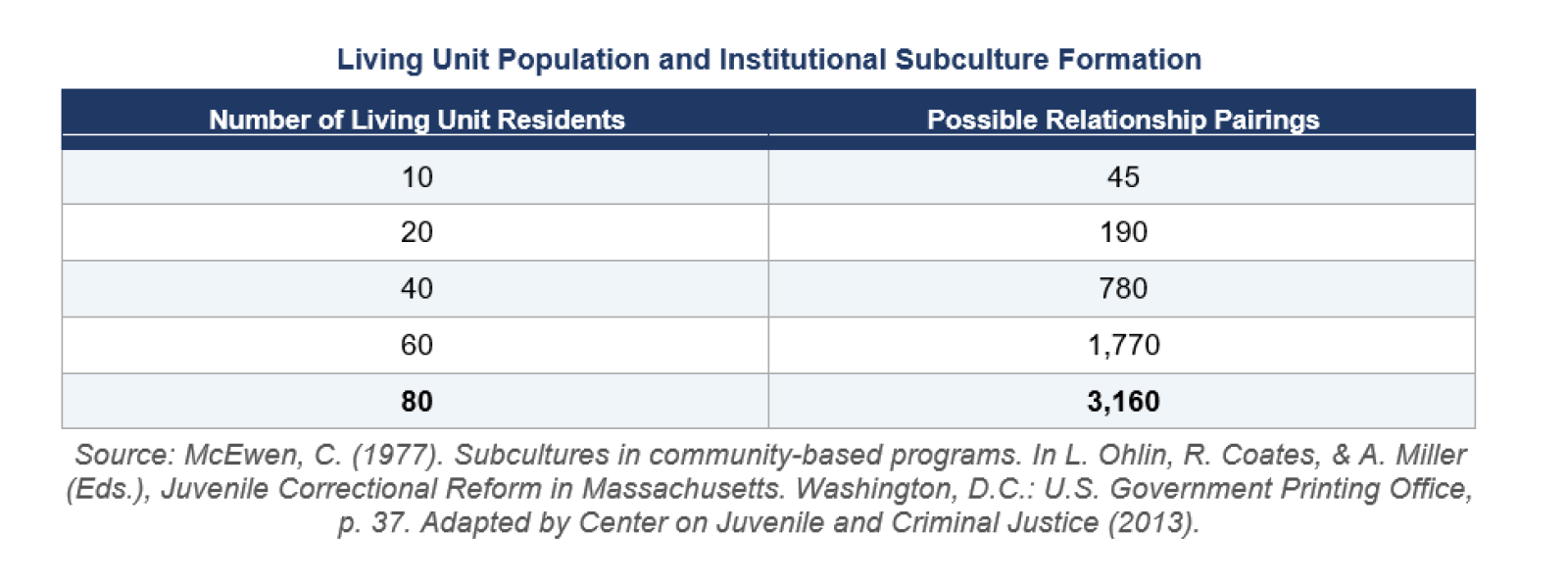
A living unit of 10 youth involves 45 possible relationship pairings. A well-trained staff team can understand and monitor 45 relationships; who is in conflict with whom, which youth is being targeted, where tensions are building before they erupt. A living unit of 80 was a standard in old CYA dormitories and involves 3,160 pairings. No staff team can manage 3,160 relationships. When staff cannot manage relationships, youth manage them. The result is the gang hierarchy, the coercion, and the institutional violence that California documented at its own facilities for decades.
This outcome is not accidental; it is structural. The Commonweal reports, the Farrell litigation, numerous CJCJ monitoring reports, and decades of practitioner testimony all describe the same dynamic in different facilities at different times because it is the structural outcome of exceeding the scale at which therapeutic supervision is possible.
Organizational Structure as the Variable: Feld’s Comparative Evidence
The Commonweal reports document what went wrong in California. Barry C. Feld’s research explains why — and points directly to what counties must do differently. In Neutralizing Inmate Violence: Juvenile Offenders in Institutions (1977) and his subsequent comparative study of ten cottage units across four juvenile institutions (1981), Feld tested two competing theories of why institutional violence emerges.
The first theory is the “importation” model. It holds that youth bring violent norms and gang affiliations into institutions from the street. On this account, the institution is largely passive: it concentrates pre-existing pathology but does not create it. The policy implication of the importation model is pessimistic for rehabilitation: if violence is imported, the institution can only manage it, not eliminate it.
The second theory is the “deprivation” model, which holds that institutional conditions themselves generate violence. Deprivation of autonomy, safety, and personal dignity produces the inmate subculture as an adaptive response. On this account, the institution is the problem: change its structure and you change its outcomes.
Feld’s comparative findings were unambiguous: organizational structure, rather than the prior characteristics of the youth confined was the decisive variable. Controlling for differences in inmates’ backgrounds across settings, he found a clear and consistent relationship between formal institutional design and inmate culture. The more custodial and punitive the setting, the more violent, hostile, and oppositional its culture. Facilities organized around therapeutic relationships experienced less violence than those organized around custody and control, regardless of whom they confined.
The specific organizational features that Feld identified as violence-reducing are directly actionable for California’s county facilities: formal collaboration between staff and youth in a democratic, egalitarian structure; consistency in responding to troublesome incidents; programmatic diversity that addresses varied individual needs; and explicit policies discouraging staff-inflicted violence. These are not program add-ons. They are structural features that determine whether a facility functions as a therapeutic environment or a custodial one.
This finding carries a specific implication for realignment that the California literature alone does not supply: population reduction is necessary but not sufficient. A county facility housing ten youth in a custodial, punitive structure will still generate violence, just at a smaller scale, closer to home, and with less visibility. The structural safeguards this report identifies as imperatives are not merely humane aspirations. Feld’s comparative evidence establishes them as the organizational preconditions for any facility that is not violence-producing.
Feld’s research also provides a historical parallel that provides California policymakers with an invaluable lesson. His work emerged from a seven-year Harvard Center for Criminal Justice study of Massachusetts’ reforms under the Department of Youth Services — a sweeping deinstitutionalization that closed the state’s training schools and transferred responsibility to community-based providers in the early 1970s. California’s realignment is the most significant structural parallel to the Massachusetts reform in the fifty years since. Feld’s analysis of what that transition got right and wrong — where institutional logic migrated into smaller settings, and where genuinely different approaches took hold — offers California counties a road map that no California-specific source can provide.
The California Treatment Project: Evidence the System Chose to Ignore
The California Youth Authority’s own researchers produced the most important evidence against large institutional confinement — and the system ignored it. The California Treatment Project (CTP), launched by the CYA in 1961 under the direction of Marguerite Q. Warren at the Center for Training in Differential Treatment, was a rigorously designed experiment comparing the outcomes of youth assigned to intensive community-based supervision against those committed to traditional Youth Authority institutional confinement.
The CTP’s findings were clear-cut. Youth assigned to intensive community-based supervision consistently showed lower rates of recidivism than those committed to institutions — and did so at substantially lower cost. The project demonstrated what practitioners had long claimed: that removing youth from their communities and concentrating them in large institutional settings produced worse outcomes than maintaining them in community environments with intensive, individualized supervision and support.
The CTP was not a marginal study. It was conducted by the Youth Authority’s own research division, published in peer-reviewed literature, and replicated across multiple cohorts over more than a decade. The evidence it produced was available to Youth Authority administrators, to the California legislature, and to every governor who oversaw the agency from the mid-1960s forward.Ted Palmer’s 1969 evaluation of the CTP put specific numbers to what the project had demonstrated. At the 24-month follow-up, youth assigned to community-based treatment showed a recidivism rate of 44 percent — compared with 63 percent for institutionalized controls, a 19 percentage point reduction representing roughly a 30 percent relative decline. The favorable discharge results were equally striking: 69 percent of experimental youth achieved favorable discharge from the CYA within 60 months, compared with 50 percent of controls. These were not small differences at the edge of statistical significance. They were large, consistent, and replicated across multiple cohorts. The study used quasi-experimental and random assignment methods that were unusually rigorous for corrections research of the era, lending the findings a credibility that subsequent rehabilitation research rarely matched (Palmer, 1969).
“Ironically, many of the reforms called for by Commonweal researchers had already been favorably proven in California. The Youth Authority’s own research on the benefits of smaller personalized institutions and community-based interventions provided much of the evidence on which Commonweal researchers could make their claims.”
The Youth Authority did not act on its own findings. The large congregate institutions continued to operate. New ones were planned and built. By 1985 — more than twenty years after the CTP began producing evidence that community-based intervention outperformed institutional confinement — the CYA’s institutional population had grown to 6,638, with average lengths of confinement increasing year over year. The persistence of the large institutions in the face of this evidence cannot be explained by ignorance. It requires a different explanation that is addressed directly in the companion analysis of why institutions persist despite documented failure.
Defining the Secure Track In County Juvenile Justice
The “secure track” refers to the post-adjudication commitment of youth convicted of serious and violent offenses to county juvenile halls operating as long-term secure facilities. It is the county-level successor to the former DJJ commitment system. The secure track has a specific legal basis, serves a defined population, operates in a specific placement type, and must be organized around a defined purpose. Defining the secure track clearly is essential. Without clear standards, counties risk treating any juvenile hall operation as sufficient to satisfy realignment’s requirements.
Legal Basis: SB 823 and the Welfare and Institutions Code
SB 823 (2020) established the legal framework for realignment by prohibiting new DJJ commitments and transferring fiscal and programmatic responsibility to counties effective July 1, 2021. It created the Juvenile Justice Realignment Block Grant, established minimum standards for county commitment facilities, and required counties to develop local juvenile justice plans.
The Welfare and Institutions Code section 202 establishes the statutory purpose: protecting public safety while advancing the best interests of youth through rehabilitation. The secure track must be understood within this framework where the ultimate purpose of confinement is achieving public safety through rehabilitation.
The Population
The secure track serves youth adjudicated for the most serious offenses — the population that would previously have been committed to the DJJ. DJJ-eligible offenses include murder, rape, robbery, carjacking, and other serious and violent felonies enumerated in the Welfare and Institutions Code. Although this population represents a small share of all juvenile court dispositions, it requires the most intensive services, the highest level of supervision, and the strongest reintegration supports.
The Placement
Under realignment, county juvenile halls serve a dual function new to most of them: short-term pre-adjudication detention and longer-term post-adjudication commitment. This dual function creates operational challenges. Counties must manage two legally distinct populations with different program requirements and legal statuses in a shared facility. Counties must address this explicitly in their facility design and operational policies. Long-term commitment populations require specialized programming, staffing models, physical environments, and institutional cultures that differ substantially from short-term detention operations. Counties that simply continue operating juvenile halls as they always have without reconceiving the institutional mission will produce poor outcomes for youth committed to their care.
The Purpose
The defining purpose of the secure track is rehabilitation — specifically, the preparation of committed youth for successful community reintegration. Secure confinement is the means while reintegration is the goal. This is a more demanding standard than the DJJ ever pursued. The DJJ’s mission statements emphasized rehabilitation while its operational practices were organized around custody, compliance, and The defining purpose of the secure track is rehabilitation — specifically, the preparation of committed youth for successful community reintegration. Secure confinement is the means while reintegration is the goal. This is a more demanding standard than the DJJ ever pursued. The DJJ’s mission statements emphasized rehabilitation while its operational practices were organized around custody, compliance, and incapacitation. The secure track under realignment must achieve a new and higher standard than the old state-run correctional facilities.
The Core Risk: Replicating Institution Failure at the County Level
Realignment creates the structural conditions for a better system, but structure alone guarantees nothing. Several county juvenile halls were already under serious scrutiny for violence and inadequate programming before realignment transferred DJJ-eligible populations. Concerns documented at facilities in Los Angeles, Contra Costa, and other counties included excessive use of isolation, inadequate mental health services, and use-of-force practices that mirrored the abuses documented in the Farrell litigation.
Early Warning Signs
County administrators and state oversight bodies must watch for the signs that a commitment facility is descending into violence and abuse:
- Living unit populations that exceed 10 youth — the structural precondition for subculture formation, regardless of what programs are offered.
- Increasing rates of in-facility violence — youth-on-youth assaults, staff use-of-force incidents, and disciplinary incident rates that signal a custodial environment rather than a therapeutic one.
- CBO access restrictions — policies that limit community organization contact with committed youth or condition CBO participation on institutional compliance, severing the community connections necessary for reintegration.
- Reentry failures — youth leaving commitment without confirmed housing, school enrollment, or service connections, reproducing the discharge cliff that drove the DJJ’s recidivism record.
- Staff misconduct complaints without investigation — the pattern that historically preceded the escalating abuse documented in the Farrell litigation.
Structural Risks
Several features of county systems create risks that require explicit policy responses:
- Dual-function facilities. The detention culture, organized around compliance and custody, will dominate the commitment function unless counties deliberately separate them in policy, staffing, and physical space.
- Probation department culture. Probation departments were not designed as treatment agencies. Their institutional incentives are organized around supervision and enforcement. Building therapeutic commitment facilities from probation infrastructure requires deliberate culture change, not just a change in assignment.
- Insufficient programming investment. Psychiatric services, therapeutic counseling, educational articulation, vocational training need sustained funding and specialized staffing. Counties that treat these as discretionary will produce custodial facilities.
- Political pressure after incidents. Escapes, in-facility violence, and high-profile crimes by recently released youth will generate pressure for punitive responses. Counties must build the policy architecture to resist these pressures before incidents occur.
The Legal and Fiscal Consequences of Failure
The structural advantages of county-based care are real, but they require deliberate activation. Smaller living units of under 10 youth reduce relationship pairings to a range that staff can therapeutically manage. Proximity to family makes sustained engagement possible and shorter sentences create the conditions for intensive reintegration work. But none of these advantages is self-executing. Each requires deliberate operational choices, adequate programming investment, and sustained leadership commitment.
The consequences of failure are legal, fiscal, and political. The litigation infrastructure that dismantled the DJJ is intact. The advocacy organizations that that monitored and exposed conditions at DJJ are still operating. The legal standard established by that the Farrell litigation applies to county facilities. Counties that allow their commitment facilities to deteriorate toward DJJ-era conditions will face the same trajectory: documented conditions generate litigation; litigation produces consent decrees; consent decrees impose external control; and external control produces fiscal and political crisis.
What Community Based Actually Means
Realignment transferred juvenile corrections to California’s counties. Transferring administrative responsibility is not the same as creating community-based corrections. The distinction matters enormously — and California’s correctional history is full of institutions that were called community-based while functioning as small versions of the institutions they replaced.
Robert Coates, whose research on community corrections defined the field, identified the essential standard: a correctional program is community-based to the degree that its staff, clients, and operations are genuinely embedded in the network of relationships — schools, employers, families, community institutions — of the specific territory from which committed youth come and to which they will return.
“The words community-based focus attention on the nature of the links between programs and the community. The key variables are the extent and quality of the relationships among program staff, clients, and the community in which the program is located.”
A county is an administrative jurisdiction, not a community in this sense. The communities that matter for realignment are specific neighborhoods, schools, and family networks — South Central Los Angeles, Fruitvale in Oakland, Fresno’s west side, Richmond’s Iron Triangle — where youth live, where their families live, and where they will return.
Building genuinely community-based corrections means building within and toward those specific local networks — not administering programs at the county level and calling it community.
“The idea of community is central to the conceptualization of community-based set forth here, but it can be used to mean many things: a small number of people sharing similar ideas; a specific territory in which a number of people reside; a group of similar background. For the arguments presented here, community will mean the smallest local territory that incorporates a network of relationships providing most of the goods and services required by persons living within the boundaries of the territory.”
California Counties and the Community Resource Network
California’s 58 counties vary dramatically in what they can offer as genuine community resource networks — the most consequential equity challenge in realignment.
In the urban communities that generate the largest share of serious juvenile justice involvement — South Los Angeles, East Oakland, Richmond, Fresno’s west side, San Bernardino — the existing resource network for justice-involved youth is severely depleted. Schools are under-resourced. Stable employment for young people with records is scarce. Affordable housing is a crisis. Mental health and substance use treatment slots are inadequate. Developing a genuine community-based system in these communities means investing in the service network those youth need. The investment required is in people, relationships, and services, not in secure beds.
In smaller rural counties — Lassen, Modoc, Trinity, Del Norte, Siskiyou — the network is thin for different reasons: geographic isolation, small population bases, and limited nonprofit infrastructure. A rural county handling a dozen serious commitments per year cannot independently sustain the specialized programming that effective secure care requires. Regional collaborative models are not optional here, they are the only viable path.
In both contexts, the policy obligation is the same: counties must actively invest in the community resource network, not simply administer programs within whatever exists. The measure of realignment’s success is whether the network of relationships and services available to justice-involved youth in their home communities is stronger at the end of the commitment period than it was at the beginning.
Five Traps That Produce Institutional Programs in Community Settings
California has a long history of correctional programs that claimed the community-based label while replicating institutional logic. County planners should recognize five patterns that consistently produce this result:
- Labeling without meeting the standard. A county juvenile hall is not community-based because it is locally administered. The label must be earned through demonstrated community relationships, family engagement, and reintegration outcomes.
- Defining community-based by contrast rather than content. Calling facilities community-based because they are not state prisons provides no affirmative standard. County systems must be built toward something, not merely away from what came before.
- Equating location with community connection. A facility located near a community is not connected to it. California’s group homes and residential programs have demonstrated repeatedly that physical proximity does not produce the therapeutic community relationships that rehabilitation requires.
- Assuming low security means community-based. Some effective community-based programs involve significant supervision. What matters is the quality of community relationships, not the level of control.
- Assuming private operation means community-based. Large private corporate providers can be as isolated from community resources and relationships as any state facility. Contracting with private providers does not produce community-based corrections.
The Reintegration Imperative
The secure track must be organized around reintegration from the moment of commitment. This is not a program philosophy applied at the back end of confinement. It is the organizing purpose that should determine every operational decision from admission through release.
California’s DJJ consistently failed at reintegration not because reintegration was absent from its mission statement, but because its operations — such as the length of confinement, the geographic isolation from family, the disconnection from community schools, and the absence of pre-release planning — rendered successful reintegration impossible. County systems that replicate those operational patterns will produce the same outcomes.
What Reintegration-Focused Operations Require
A secure track organized around reintegration looks different from the DJJ in every operational dimension:
- Reintegration planning begins at admission — not at the 90-day mark before release. Within 30 days of commitment, every youth must have a documented plan identifying the community to which they will return, the family situation, the school or education program, the housing arrangement, and the service providers who will support them.
- Family engagement is a core institutional function, not a visiting policy. Regular, in-person family contact; family therapy; and family support services throughout confinement are programmatic requirements, not discretionary amenities.
- Community connections are maintained throughout confinement. Community-based organizations embedded in the youth’s home community maintain contact during the commitment period, building the relationships that will sustain the youth after release.
- Shorter confinement periods are a structural advantage that must be preserved. Research on adolescent development is consistent: long-term confinement beyond the minimum necessary for stabilization and treatment is inversely related to reintegration success. Counties must resist political pressures that extend confinement beyond what rehabilitation requires.
- Release should never result in homelessness or impoverishment. Housing, school enrollment, employment, and service support must be in place before release. Youth must not leave a commitment facility without a complete, active reintegration plan.
The Stakes for California
Realignment is California’s most significant juvenile justice reform since the founding of the juvenile court in 1903. Its credibility will be determined not by what happens to the majority of youth — those diverted, supervised in the community, or served through non-secure programs — but by what happens to the small number committed to secure county facilities. If those facilities reproduce the violence, abuse, and recidivism of the institutions they replaced, realignment will have reorganized failure at a smaller scale. If they build something genuinely different, they will have demonstrated what California corrections has never managed to demonstrate: that secure confinement and genuine rehabilitation are compatible.
The consequences of failure are concrete. Legally: the litigation and advocacy infrastructure that dismantled the DJJ is intact, the organizations that filed Farrell and monitored conditions are still operating, and the legal standard established by that consent decree applies to county facilities. Fiscally: the costs of consent decree compliance, mandated reforms, and eventual closures will far exceed the cost of operating existing facilities correctly from the beginning. And the communities that realignment is supposed to serve — the neighborhoods already bearing the weight of concentrated poverty, under-resourced schools, and inadequate services — will bear the public safety costs of inadequate county secure care.
California’s counties have structural advantages the DJJ never had: smaller scale, proximity to families, local accountability, and shorter confinement periods. California also has it’s 9,113 juvenile hall beds running at barely 31 percent of capacity — more than enough physical infrastructure, with 6,252 beds sitting empty (BSCC, 2026, 2026a). The policy choices required to convert those structural and physical advantages into genuine rehabilitative outcomes are specific, demanding, and knowable. The companion report to this paper — The Secure Track: The Implementation Framework — sets out in operational detail how counties should configure and operate existing facilities to meet the standards this paper argues they must meet.
Selected References
Board of State and Community Corrections (BSCC). (2026). Juvenile Detention Profile Survey Query. At: https://www.bscc.ca.gov/s_
Board of State and Community Corrections (BSCC). (2026a). Rated Capacities of Juvenile Detention Facilities. At: https://www.bscc.ca.gov/s_
Center on Juvenile and Criminal Justice. (2025). Nonprofit community-based organizations: Central partners in service delivery and systems reform.
California Juvenile Justice Realignment Reform Report Series, Report No. 1. Daniel Macallair, Executive Director.
Coates, R.B. (1977). Community-based corrections: Concept, impact, dangers. In L.E. Ohlin, A.D. Miller, & R.B. Coates, Juvenile correctional reform in Massachusetts. Washington, D.C.: U.S. Government Printing Office.
Lerner, S. (1982). The CYA report: Conditions of life at the California Youth Authority. Bolinas, CA: Common Knowledge Press (Commonweal Research Institute).
Lerner, S. (1986). The CYA report (Part II): Bodily harm: The pattern of fear and violence at the California Youth Authority. Bolinas, CA: Common Knowledge Press (Commonweal Research Institute).
DeMuro, P., DeMuro, A., & Lerner, S. (1988). Reforming the CYA: How to end crowding, diversify treatment, and protect public safety. Bolinas, CA: Commonweal.
Farrell v. Allen, No. RG 03 – 079344 (Alameda County Superior Court, 2003).
Feld, B.C. (1977). Neutralizing inmate violence: Juvenile offenders in institutions. Cambridge, MA: Ballinger.
Feld, B.C. (1981). A comparative analysis of organizational structure and inmate subcultures in institutions for juvenile offenders. Crime and Delinquency, 27(3), 336 – 363.
Macallair, D. (2015). After the Doors Were Locked: A History of Youth Corrections in California and the Origins of Twenty-First Century Reform. Rowman & Littlefield.
Macallair, D., Reséndez, G., & Washburn, M. (2023). Beyond Repair: Envisioning a Humane Future After 132 Years of Brutality in California’s Youth Prisons. Center on Juvenile and Criminal Justice.
National Research Council. (2013). Reforming juvenile justice: A developmental approach. National Academies Press.
Palmer, T. (1969). California’s Community Treatment Project in 1969: An assessment of its relevance and utility to the field of corrections. Sacramento: California Department of the Youth Authority, Community Treatment Project.
SB 823 (2020). California Juvenile Justice Realignment. Chapter 337, Statutes of 2020.
California Welfare and Institutions Code § 202; § 875.
AI Disclosure: This report was prepared with the assistance of AI tools. All analysis, writing, conclusions, and editorial judgments are the author’s own.