Executive Summary
Proposition 36, which took effect in late 2024, promised California voters a new era of “mass treatment” for people struggling with addiction. But early evidence suggests it has simply boosted incarceration, while failing to get Californians connected to treatment. These failures reflect flaws in the initiative’s design, poor implementation, and counties’ refusal to redirect law enforcement dollars, particularly Public Safety Realignment funding, towards treatment.
This report draws on data from the Judicial Council, the Board of State and Community Corrections, public defenders, and partner research organizations to assess Proposition 36’s performance in its first year. The data point to several key challenges:
- Incarceration is climbing. Nearly 900 Californians have already been sent to state prison on Proposition 36 charges. Jail populations have grown by nearly 3,000 since Proposition 36’s passage, driven by a surge in unsentenced felony bookings. These 2025 data represent a reversal of yearslong declines in incarceration, and they are occurring amid all-time lows in California’s crime rate.
- Treatment offerings fall short of the need. Fewer than one in five people arrested on Proposition 36 drug charges have been ordered to treatment, and fewer than one in one hundred have completed a program. Long wait times for treatment beds, high costs, and the inherent limitations of court-mandated treatment, are contributing to this gap.
- Enforcement is arbitrary. Charging rates vary dramatically by county, with Orange County alone accounting for nearly 20% Proposition 36 charges and 40% of theft convictions, despite representing just 8% of the state’s population. Some prosecutors are charging far more Proposition 36 drug offenses, while others are opting for more theft offense charges. This inconsistency across counties exacerbates California’s longstanding problem of providing differing “justice by geography.”
- Communities of color bear the brunt. Black Californians are dramatically overrepresented in Proposition 36 charges. In Contra Costa County, for example, Black residents account for more than half of all Proposition 36 theft charges despite making up less than one-tenth of the population.
Proponents have claimed that funding shortfalls explain these outcomes. But California already allocates $2 billion annually in Public Safety Realignment (AB 109) funds meant to serve people with low-level offenses. These dollars flow primarily to probation and sheriff’s departments whose caseloads have fallen sharply over the past several decades. Counties have the resources to address the demand for treatment beds created by Proposition 36. What they lack is a commitment to reinvesting them.
Introduction
Since taking effect in late 2024, Proposition 36 has imposed steep costs on local criminal justice systems, greatly expanded the power of the prosecutor, and set off a dangerous return to mass incarceration. At the same time, Proposition 36 has failed to deliver on its key campaign promise: providing mass substance use treatment to Californians suffering from addiction.
Passed by voters in November of 2024, Proposition 36 allows district attorneys to charge certain repeat theft and low-level drug offenses as felonies. This reversed portions of 2014’s Proposition 47, which had reduced these offenses from possible felonies to misdemeanors.
Proposition 47 provided a clear mechanism for redirecting state funds into community-based prevention and treatment programs. Proposition 36 did not. Rather, in the months after its passage, law enforcement interest groups lobbied lawmakers to include hundreds of millions of Proposition 36 implementation funding in the state budget and failed. This failure has since served as useful cover amid the initiative’s foundering rollout. However, funding gaps are an unsatisfying explanation for Proposition 36’s early challenges for two reasons.
First, the initiative’s failures stem largely from its design. Decades of research have shown that homelessness and addiction are public health issues, not criminal ones. Arresting and jailing people in the throes of addiction, even when paired with a treatment mandate, is not effective at addressing underlying issues and often exacerbates them.
Second, the state is already allocating $2 billion each year that is intended to serve people with low-level offenses. In some counties, these dollars go unspent or misused, and, in most, they flow to criminal justice agencies whose caseloads have been shrinking for years. State leaders recently eliminated all reporting requirements on Public Safety Realignment (AB 109) funding, allowing counties to spend without public accountability. This is likely to worsen an existing problem: that funds are being directed, reflexively, to law enforcement with too little reaching the community programs that meet Californians’ critical mental health, housing, substance use disorder, and employment needs.
Proposition 36 was modeled on the failed “tough on crime” strategies of the past. These approaches created a revolving door of incarceration, homelessness, and addiction, but did nothing to address the root causes of crime. Now, Proposition 36 is straining both the criminal justice system and the state’s already-inadequate treatment infrastructure. Rather than chasing new state dollars or siphoning money from effective grant programs, such as Proposition 47 funds, counties should redirect existing AB 109 funding to meet Proposition 36’s rising costs.
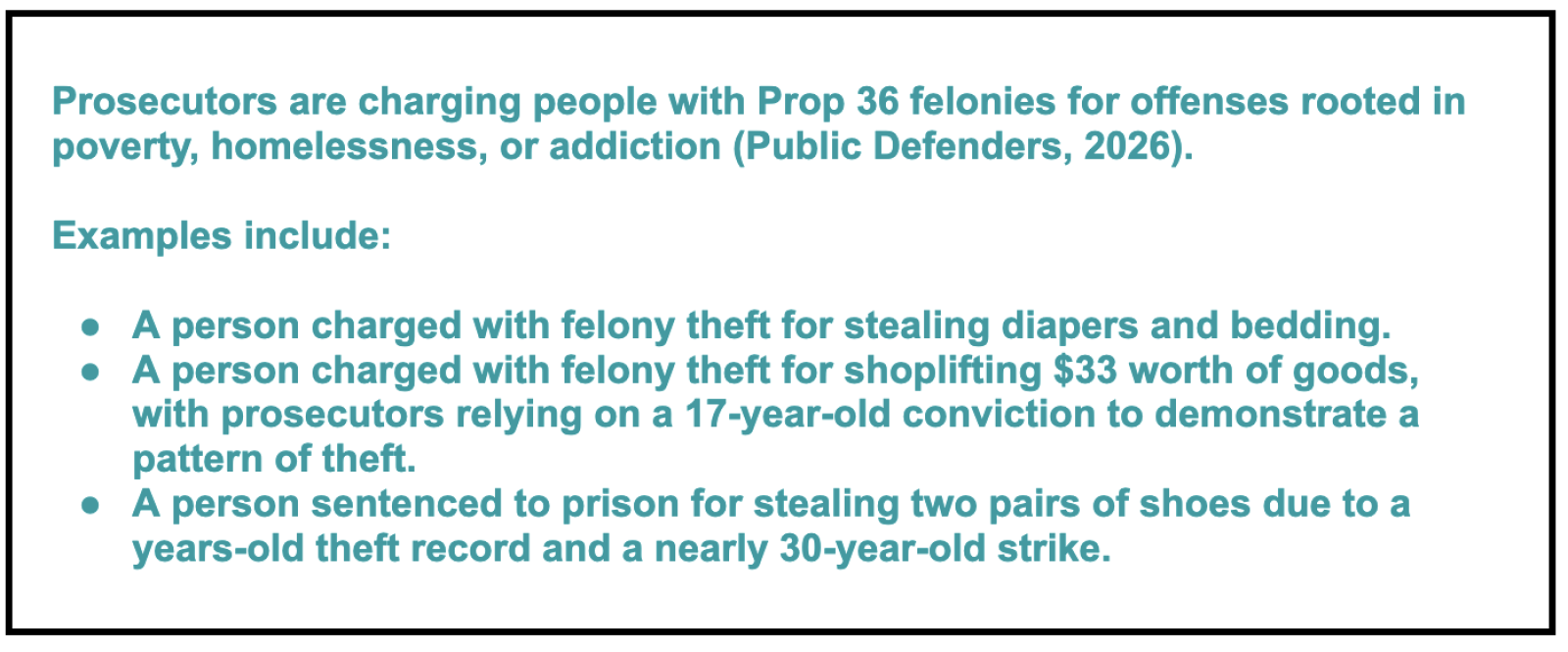
Data
This report draws from public data sources, including the Judicial Council (Judicial Council, 2026) and the Board of State and Community Corrections (BSCC, 2026), as well as information obtained through partnerships with research groups and public agencies, including public defender offices (Public Defenders, 2026) and the New York University Public Safety Lab’s Jail Data Initiative (JDI, 2026).
Figure 1. Proposition 36 charges filed, by offense type and level, 2025
Veiled Return to Mass Incarceration
Rather than ushering in the “era of mass treatment” proponents promised, Proposition 36 appears to be expanding incarceration — even as crime continues to fall across the state.
In 2025 alone, prosecutors filed nearly 40,000 criminal charges under Proposition 36 (Figure 1). As a result, the number of Californians behind bars has grown steadily over the past year, with increases in both jail populations and Proposition 36 state prison commitments.1 Newly released data show that jail populations rose by 2,600 from November 2024, just before the initiative took effect, to November 2025, one year later (BSCC, 2026). That increase was driven largely by an increase of 3,100 additional bookings for nonsentenced felonies, the category under which most Proposition 36 bookings would be recorded (see Figure 2).
Figure 2. California jail population, January 2024 to September 2025
Data from California prisons tell an even clearer story of Proposition 36’s impact. Nearly 900 Californians were sentenced to state prison on Proposition 36 charges between January 2025 and January 2026, with monthly admissions rising steadily after implementation (California Policy Lab, 2026) (Figure 3).2 Most of these imprisonments are for theft offenses (about 70%) rather than drug offenses (about 30%) (California Policy Lab, 2026). This trend, in combination with the rising pretrial population in jails, suggests that Proposition 36 incarceration may continue to increase in the years to come.
Figure 3. Prop 36 prison admissions, January 2025 to January 2026
Increases in jail populations are occurring against a backdrop of falling crime. Crime rates in California are at an all-time low, having declined an estimated 10% over the November 2024 to November 2025 period (FBI, 2026).3 This continues a multi-year downward trend across every major crime category, meaning that, paradoxically, California is poised to incarcerate increasing numbers of people in an era of unprecedented safety.
Treatment Failures
The vast majority of people charged with drug offenses under Proposition 36 are not receiving treatment. According to the Judicial Council of California, just 17%4 of felony cases filed under Health and Safety Code 11395 resulted in people being placed into treatment, and only 0.3%5 resulted in a dismissal of charges following the successful completion of treatment (Judicial Council, 2026). Data from public defenders and the broader public health literature help explain why this gap exists and why, even for those who do enter treatment, the outcomes are often poor.
The research on mandated treatment is clear: court-ordered programs are often ineffective at helping people overcome addiction (Gibbs, 2018; Pasareanu, 2016; Wakeman, 2023; Wegman, 2017; Werb, 2016). For many, mandated programs feel coercive. This perception strains the therapeutic relationship, making it more difficult for patients to engage in treatment and connect with their clinicians (Sheehan & Burns, 2011).
Another key shortcoming is mandated treatment’s intolerance for relapse. Relapse is common in recovery, yet courts typically do not offer second chances when it occurs (DiClemente & Crisafulli, 2022). Instead, people who relapse while mandated to treatment can face criminal charges and jail time. Incarceration only compounds the underlying problem because it subjects people with unaddressed needs to an inherently non-therapeutic environment. Research shows that incarceration worsens addiction and can significantly increase a person’s risk of overdose and death (Binswanger, 2013; Fiscella, 2020; Hartung, 2023; Western & Simes, 2013).6
“If you relapse twice, you’re out. That’s horrible. Relapse is expected in the recovery process. People are excluded if they pick up another drug case. People don’t heal when they’re afraid.”
For others, mandated treatment is ineffective because court-ordered programs are generally not tailored to the individual needs of participants (SSRC, 2018). For example, some participants do not require intensive treatment, but are nonetheless placed in a one-size-fits-all program by the court. Enrollment in these programs may not confer additional benefits, but will shrink the pool of available beds for others who require a higher level of care (PHR, 2018). This mismatch can lead to ineffective treatment and continued substance use problems — both for those facing Proposition 36 charges and for those in the community.
Gaps in county practices exacerbate this problem. Many California counties do not routinely assess treatment needs or help people access benefit programs to cover the cost of it. Nineteen of 52 reporting counties do not regularly order a substance use and mental health evaluation in Proposition 36 drug cases, and 28 do not assess whether people with Proposition 36 drug charges qualify for Medi-Cal, Medicare, or other benefits that could defray treatment costs (Judicial Council, 2026).
Judicial Council data on treatment outcomes tell a similar story about the efficacy of mandated treatment. Of those who entered treatment on a Proposition 36 drug charge and later exited, roughly 80% had a judgment imposed against them, while only 20% succeeded in treatment and had their charges dismissed (Judicial Council, 2026).7
Yet an even larger share of people are not enrolling in treatment at all under Proposition 36. Part of the explanation is supply. Many counties simply do not have enough treatment beds to serve the Proposition 36 population without placing people on long waitlists (Mai-Duc, 2025; Lagos, 2024; Public Defenders, 2026; Vera Institute of Justice, 2025). However, demand is a problem as well. Many people charged with a Proposition 36 drug offense are declining treatment outright. For some, program length or intensity is a factor in the decision. For others, it is a matter of readiness. Knowing that they are likely to struggle in a structured program — and may ultimately face criminal justice system consequences — reduces their incentive to enroll (Public Defenders, 2026).
In some cases, Proposition 36 is not functioning as a pathway into treatment at all. Many prosecutors are using the threat of a felony charge as leverage to extract lesser plea deals, which, in turn, offer no meaningful incentive or opportunity for treatment (Public Defenders, 2026). Misdemeanor cases, which may appear to be more lenient, still carry serious and lasting consequences. First, those booked on a Proposition 36 charge, regardless of whether it resolves as a felony or misdemeanor, are experiencing the harms of an arrest, a jail booking, and a court process. This can affect their jobs and families, all while deepening their underlying substance use or mental health issues. Secondly, a misdemeanor conviction becomes part of an individual’s criminal record, all but ensuring harsher penalties for any future offenses (Public Defenders, 2026). Finally, Proposition 36 has given prosecutors the upper hand, leaving many with no choice but to waive their constitutional rights, including the right to present a defense at trial. This is the unfortunate byproduct of a legal system that places significant power in the hands of prosecutors — a power that has greatly expanded under Proposition 36 (Subramanian et al., 2020).
“In our misdemeanor theft cases…you used to be able to get them dismissed. Now you can’t. They want to build the priors.”
Unequal Application
Counties across California are applying Proposition 36 haphazardly, producing stark geographic disparities in how the law is enforced. The result is that Californians face vastly different forms of justice depending on where they live, a practice known as “justice by geography.”
Figure 4. Proposition 36 charges (misdemeanor and felony) per 100,000 population, 2025
The disparities are striking (see Figure 4). Orange County is home to just one-twelfth of the state’s population, yet its residents account for more than one in five Proposition 36 charges and 40% of the state’s Proposition 36 theft convictions (DOF, 2026; Judicial Council, 2026). In fact, Orange County residents face roughly 10 times the risk of being charged with a drug felony under Proposition 36 compared to residents of neighboring Los Angeles County (DOF, 2026; Judicial Council, 2026). Statewide, several counties diverge sharply from the average: Kern, Orange, and Stanislaus each file Proposition 36 charges at more than twice the state rate, while Alameda, Contra Costa, Los Angeles, and San Francisco file well below it (DOF, 2026; Judicial Council, 2026). At the extremes, Stanislaus files Proposition 36 charges at eight times San Francisco’s per-capita rate (DOF, 2026; Judicial Council, 2026).
The pattern extends beyond a handful of outliers. Residents of smaller, rural counties are being charged at disproportionately high rates relative to their urban counterparts. Counties with populations under 100,000 (20 counties) file Proposition 36 charges at 1.5 times the rate of the state’s largest counties (10 counties with populations over one million) (DOF, 2026; Judicial Council, 2026). These differences are even more pronounced for Proposition 36 drug felonies. The smallest counties file these charges at more than twice the rate of the largest (DOF, 2026; Judicial Council, 2026). These gaps follow regional patterns as well. For example, Central Valley counties file Proposition 36 charges at 1.7 times the rate of Bay Area Counties, with drug charging, in particular, outpacing Bay Area rates three to one (DOF, 2026; Judicial Council, 2026).
Counties also differ sharply in whether they are using Proposition 36 primarily to charge theft or drug offenses. In several Bay Area counties, including Alameda and Santa Clara, prosecutors are pursuing far more theft cases than drug cases (Judicial Council, 2026). In other California counties, including several in Southern California, the pattern reverses: district attorneys are more aggressively pursuing drug cases using Proposition 36 ( Judicial Council, 2026; Public Defenders, 2026; San Diego County District Attorney, 2026). The contrast is striking in Alameda and San Diego counties. In Alameda County, just 1% of Proposition 36 cases involve drug offenses, compared to 67% in San Diego (Judicial Council, 2026; Public Defenders, 2026; San Diego County District Attorney, 2026).
As discussed earlier, these disparities reflect the significant and expanded discretion granted to prosecutors through Proposition 36 (Davis, 2018).
Disparate Harm
Proposition 36 is deepening already profound racial disparities within the criminal justice system, particularly for Black Californians.
Data from public defenders and the Jail Data Initiative (JDI, 2026) show clear racial disproportionality in charging under Proposition 36. In Contra Costa County, Black residents make up just 9% of the population, but account for 52% of Proposition 36 theft charges and 30% of drug charges (DOF, 2026; Public Defenders, 2026). Alameda County shows a similar picture. Black residents are 9% of the population but account for 63% of Proposition 36 theft charges (DOF, 2026; Public Defenders, 2026). In Napa County, Black residents are 2% of the population but account for 26% of theft charges, and in Kings County, Black residents are 4% of the population but account for 20% of theft charges (DOF, 2026; JDI, 2026). Even in counties where Black residents represent just 1 – 2% of the population, such as Santa Cruz and Sutter, their share of Proposition 36 charges runs four to five times higher (DOF, 2026; JDI, 2026).
These disparities extend to some Latino Californians as well. In Santa Clara County, Latino residents make up 21% of the population, but they account for 38% of Proposition 36 theft charges and 55% of drug charges (Public Defenders, 2026).
The breadth of these disparities — affecting both large and small, rural and urban counties — suggests a broader pattern of racial injustice. The harsher penalties and collateral consequences of Proposition 36 fall most heavily on people of color.
Flimsy Excuses
Proponents of Proposition 36, including many law enforcement leaders, have pointed to a lack of state funding to explain the initiative’s early failures (Davis & Figueroa, 2025; Mihalovich, 2025). Nevertheless, counties have shown an unwillingness to tap AB 109 funding — a multibillion-dollar state funding stream that is ripe for reinvestment (CJCJ, 2024; 2025). With virtually no public transparency, AB 109 now resembles a law enforcement slush fund, but has the potential to become a critical tool in building out the state’s community-based treatment infrastructure.
Under AB 109, counties receive approximately $2 billion each year. The goal of these funds was to compensate counties for the costs of Public Safety Realignment, which, in 2011, shifted responsibility for those with nonserious, nonsexual, and nonviolent offenses from state prisons to county custody (AB 109, 2011). Today, these funds are the equivalent of roughly one-seventh of the state’s entire prison budget and represent one of the largest state-level criminal justice disbursements in the nation.
An estimated two-thirds of AB 109 funds currently flow to probation and sheriff’s departments (CJCJ, 2024; 2025). Yet these same agencies have seen sizable drops in their populations and supervision caseloads across the nearly 15 years since AB 109 took effect: nearly a 50% decline for probation and nearly a 20% decline for sheriffs (Figure 5 and Figure 6). In fact, a decade ago, California sheriff’s departments received less than $10,000 in AB 109 funds for each person incarcerated in their jails. But by 2024, due to declining jail populations and fairly stable levels of AB 109 funding, these departments were receiving nearly $15,000 per incarcerated person (all in 2025 dollars) (CJCJ, 2025). Rather than build up sheriff or probation coffers, AB 109 funds should follow the individual — from incarceration into the community, with funding flowing to community-based treatment providers.8
Figure 5. Probation department caseloads, 2011 – 2024
Figure 6. Average daily population in California jails, 2011 – 2025
However, a major barrier to reinvestment are Community Corrections Partnerships (CCPs). CCPs are county-level committees that decide how AB 109 funds are spent. They are chaired by each county’s Chief Probation Officer, a primary recipient of AB 109 funds (CJCJ, 2024; PEN § 1230). Other CCP members include sheriffs, police chiefs, and district attorneys. Law enforcement dominance on these little-known committees has translated into law enforcement dominance in AB 109 funding allocations (CJCJ, 2024; 2025).
In some counties, that dominance has produced a pattern of misuse. Numerous CCPs have allowed AB 109 dollars to accumulate in contingency funds, which can go unused for years on end, representing a missed opportunity to support vulnerable Californians (CJCJ, 2024; 2025). Other counties have directed funds towards entities with little connection to AB 109’s goals. Contra Costa County, for example, allocated nearly half a million dollars to a law enforcement advocacy organization that has lobbied against criminal justice reform (CJCJ, 2024; 2025). In other counties, CCPs have funneled state dollars toward large for-profit corrections companies, rather than the nonprofit community-based providers that are most effective at reducing recidivism and breaking cycles of incarceration (CJCJ, 2024; 2025).9
Despite its size and sometimes dubious uses, state lawmakers dealt a final blow to transparency in mid-2025 by stripping AB 109 funding of all remaining reporting requirements. Now, the state-level Board of State and Community Corrections, which had overseen the funding stream, “is no longer required to collect and analyze data regarding the implementation of CCP plans annually” (AB 134, 2025; BSCC, 2025; Penner, 2025). State lawmakers and the public can no longer track how these funds are being spent.
After more than a decade of counties folding AB 109 money into their budgets, reporting had become an empty exercise. One BSCC staff member explained: “After 10 years, the counties were doing business as usual.”
Meanwhile, the need to support people with low-level offenses is urgent and growing. Proposition 36 is costing local justice systems millions of dollars and has created significant unmet demand for treatment beds (Vera Institute, 2025). To help offset these costs, the state has turned to Proposition 47 funds, siphoning tens of millions of dollars away from well-run community programs to pay for Proposition 36 ones (CJCJ, 2024a; BSCC, 2025a). But Proposition 47 funds are just one-twentieth the size of AB 109 and have a track record of success, making them a poor substitute.
Conclusion
In the year since Proposition 36 took effect, incarceration has been rising, counties are failing to deliver mass treatment, prosecutors are applying the law unevenly, and its costs are falling hardest on communities of color. Proposition 36 is not failing because the state lacks the resources to implement it, but rather because it was built on a flawed premise: that a criminal justice approach can solve what is fundamentally a public health crisis.
The claim that a lack of state funds explains these failures is unconvincing. The state already allocates $2 billion each year in AB 109 funds intended to serve those with low-level offenses. These funds are poorly spent, essentially untracked, and overdue for reinvestment. Meanwhile, the state is raiding the Proposition 47 grant programs in the name of Proposition 36, shortchanging effective interventions.
Counties do not need new dollars to pay for Proposition 36. Rather, they must commit to reinvesting existing ones.
Sources
Alameda County. (2025). Alameda County’s Community Corrections Partnership Report & Plan. At: https://www.bscc.ca.gov/wp-con….
Assembly Bill 1603 (AB 32). (2019). Detention facilities: private, for-profit administration services. At: https://leginfo.legislature.ca….
Assembly Bill 74 (AB 74). (2019). Budget Act of 2019. At: https://legiscan.com/CA/text/A….
Assembly Bill 109 (AB 109). (2011). Criminal justice alignment. At: https://leginfo.legislature.ca….
Assembly Bill 134 (AB 134). (2025). Public Safety. At: https://www.bscc.ca.gov/wp-con….
Assembly Budget Subcommittee No. 6. (2026). Informational Hearing Agenda: March 2, 2026. At: https://abgt.assembly.ca.gov/s….
Binswanger, I.A., et al. (2013). Mortality After Prison Release: Opioid Overdose and Other Causes of Death, Risk Factors, and Time Trends From 1999 to 2009. Annals of Internal Medicine. At: https://www.ncbi.nlm.nih.gov/p….
Board of State and Community Corrections (BSCC). (2025). Realignment and Community Corrections Partnerships. At: https://www.bscc.ca.gov/m_real…;
Board of State and Community Correction (BSCC). (2026). Jail Profile Survey. At: https://jpjdreporting.bscc.ca.….
California Department of Corrections and Rehabilitation (CDCR). (2026). Weekly Total Population Report (TPOP4) Archive. At: https://www.cdcr.ca.gov/resear….
California Department of Finance (DOF). (2026). P‑2D County Population by Total Hispanic and Non-Hispanic Race. At: https://dof.ca.gov/forecasting….
California Department of Justice (DOJ). (2026). OpenJustice. At: https://openjustice.doj.ca.gov….
California Policy Lab. (2026). Prop 36 (2024) Prison Data: Monthly Updates. At: https://capolicylab.org/prop‑3….
California Secretary of State (SOS). (2026). Campaign Finance: Yes on Prop 36 — Californians for Safer Communities, Sponsored by Golden State Communities. At: https://cal-access.sos.ca.gov/….
Center on Juvenile and Criminal Justice (CJCJ). (2024). Unseen Billions. At: https://www.cjcj.org/reports‑p….
Center on Juvenile and Criminal Justice (CJCJ). (2024a). Proposition 47 Delivers Nearly $1 Billion to California Communities. At: https://www.cjcj.org/reports— publications/report/proposition— 47— delivers— nearly— 1— billion— to— california— communities.
Center on Juvenile and Criminal Justice (CJCJ). (2025). Property Crime Reached Record Lows in 2024 — Before Prop 36 Even Took Effect. At: https://www.cjcj.org/reports‑p….
Center on Juvenile and Criminal Justice (CJCJ). (2025). AB 109 Can Fund Drug Treatment Rather Than Bloated Law Enforcement Bureaucracies. At: https://www.cjcj.org/reports‑p….
Center on Juvenile and Criminal Justice (CJCJ). (2026). A Historical Timeline of California’s Prisons. At: https://www.cjcj.org/legacy-im….
Davis, A. (2018). Meet the Criminal Justice System’s Most Powerful Actors. The Appeal. At: https://theappeal.org/meet-the….
Davis, K. & Figueroa, T. (2025).California Law Leaves Defendants Responsible for Finding Drug Treatment. The San Diego Union-Tribune. At: https://www.governing.com/poli….
DiClemente, C. & Crisafulli, M. (2022). Relapse on the Road to Recovery: Learning the Lessons of Failure on the Way to Successful Behavior Change. At: https://pmc.ncbi.nlm.nih.gov/a….
Federal Bureau of Investigation (FBI). (2026). Data Discovery Tool. At: https://cde.ucr.cjis.gov/LATES….
Fiscella, K., et al. (2020). Drug- and Alcohol-Associated Deaths in U.S. Jails. Journal of Correctional Health Care. At: https://pubmed.ncbi.nlm.nih.go….
Gibbs, B.R., et al. (2018). Outcome Effects on Recidivism Among Drug Court Participants. Criminal Justice and Behavior. At: https://journals.sagepub.com/d….
Hartung, D.M., et al. (2023). Fatal and nonfatal opioid overdose risk following release from prison: A retrospective cohort study using linked administrative data. Journal of Substance Use Addiction Treatment. At: https://pubmed.ncbi.nlm.nih.go….
Jail Data Initiative (JDI). (2026). Individual data. Granted by request.
Judicial Council of California. (2025). Preliminary Proposition 36 Court Data (December 2024 to June 2025), as required by the Budget Act of 2025 (October). At: https://courts.ca.gov/system/f….
Judicial Council of California. (2026). Annual Proposition 36 Court Implementation Report. At: https://courts.ca.gov/system/f….
Lagos, M. (2024). Can Tough-on-Crime Proposition 36 Solve Theft, Drug Use and Homelessness, Despite No New Funding? KQED. At: https://www.kqed.org/news/1201….
Mai-Duc, C. (2025). As California’s Behavioral Health Workforce Buckles, Help Is Years Away. LA Times. At: https://www.latimes.com/busine….
Mihalovich, C. (2025). LA jails scale back opioid addiction treatment as fatal overdoses continue. CalMatters. At: https://calmatters.org/justice….
Mihalovich, C. (2025a). California’s Prop. 36 promised ‘mass treatment’ for defendants. A new study shows how it’s going. CalMatters. At: https://calmatters.org/justice….
Mitchell, O., et al. (2012). Drug Courts’ Effects on Criminal Offending for Juveniles and Adults. At: https://onlinelibrary.wiley.co….
National Academies of Sciences, Engineering, and Medicine. (2019). Medications for opioid use disorder save lives. The National Academies Press. At: https://doi.org/10.17226/25310.
National Institute of Drug Abuse (NIDA). (2026). Treatment and Recovery. At: https://nida.nih.gov/publicati….
Pardo, D. (2025). A year after Proposition 36: Counties show mixed results on repeat theft and treatment mandates. Spectrum News. At: https://spectrumnews1.com/ca/s….
Pasareanu, A.R. (2016). Improved drug-use patterns at 6 months post-discharge from inpatient substance use disorder treatment: results from compulsorily and voluntarily admitted patients. BMC Health Service Research. At: https://www.ncbi.nlm.nih.gov/p….
California Code, Penal Code § 1230 (PEN § 1230). At: https://leginfo.legislature.ca…§ionNum=1230.
Penner, L. (2025). Re: Community Corrections Partnership Plan Submission Requirements. At: https://www.shastacounty.gov/m….
Proposition 36 (Prop 36). (2024). November 5, 2024, General Election Voter Information Guide — Proposition 36 Text of Proposed Laws. At: https://vig.cdn.sos.ca.gov/202….
Physicians for Human Rights (PHR). (2017). Neither Justice nor Treatment: Drug Courts in the United States. At: https://phr.org/wp-content/upl…;
Public Defenders. (2026). Information and data collected through conversations and correspondence with the following public defenders: Alameda County, Contra Costa County, Kern County, Monterey County, Riverside County, Sacramento County, Santa Clara County,
San Diego County District Attorney. (2026). Proposition 36: Making Our Community Safer. At: https://www.sdcda.org/preventi….
Sheehan, K.A. & Burns, T. (2011). Perceived coercion and the therapeutic relationship: a neglected association? Psychiatr Serv, 62(5):471 – 6. At: https://psychiatryonline.org/d….
Social Sciences Research Council (SSRC). (2018). Drug Courts in the Americas. At: https://www.ssrc.org/publicati…;
State Controller’s Office (SCO). (2026). Community Corrections (formerly Local Community Corrections). At: https://www.sco.ca.gov/ard_pay….
Subramanian, R., Digard, L., Washington II, M., & Sorage, S. (2020). In the Shadows: A Review of the Research on Plea Bargaining. Vera Institute of Justice. At: https://vera-institute.files.s….
Vera Institute of Justice. (2025). One Year of Proposition 36 in Los Angeles County. At: https://vera-advocacy-and-part….
Wakeman, S.E. (2023). Why involuntary treatment for addiction is a dangerous idea. STAT News. At: https://www.statnews.com/2023/…;
Wegman, M.P., et al. (2017). Relapse to opioid use in opioid-dependent individuals released from compulsory drug detention centres compared with those from voluntary methadone treatment centres in Malaysia: a two-arm, prospective observational study. Lancet Glob Health. At: https://pubmed.ncbi.nlm.nih.go….
Werb, D., et al. (2016). The effectiveness of compulsory drug treatment: A systematic review. International Journal of Drug Policy. At: https://www.sciencedirect.com/….
Western, B. & Simes, J.T. (2013). Drug use in the year after prison. Social Science Medicine. At: https://www.sciencedirect.com/….
- 1 The California Correctional Peace Officers’ Association (CCPOA), which represents California’s prison guards, donated $300,000 to the Proposition 36 campaign (SOS, 2026). This donation was the campaign’s sixth largest and came amid steep declines in prison populations and the closure of several large state prisons (CJCJ, 2026). Now, Proposition 36 prison admissions are slowing, though not reversing, the decline in California’s prison population (CDCR, 2026). ↩
- 2 In early 2026, the California Department of Finance estimated that, once established, Proposition 36 would increase the prison population by 1,200 people. However, this analysis only considered data from the first six months of implementation (Assembly Budget Sub 6, 2026). As shown in Figure 3, Proposition 36 prison admissions increased substantially after June 2025. For this reason, the Legislative Analyst’s Office (LAO), a non-partisan advisor to the Legislature, testified at a legislative hearing in March 2026 that populations could be higher than predicted (Assembly Budget Subcommittee No. 6, 2026). ↩
- 3 In 2024, when California voters passed Proposition 36, property crime rates were at their lowest levels ever recorded (CJCJ, 2025). These statistics stood in stark contrast to the campaign’s messaging, which highlighted crime and so-called “quality of life” concerns as rationales for rolling back prior criminal justice reform (Lagos, 2024). ↩
- 4 This finding is based on data from 53 courts. When presenting information on a smaller subset of 29 counties for which full treatment pipeline information was available, Judicial Council reported that the share of felony charges that culminated in treatment was just 12% (Judicial Council, 2026). ↩
- 5 This number is expected to rise as participants complete lengthy treatment programs. ↩
- 6 Many California jails are out of step with best practices in substance use disorder treatment. In fact, Los Angeles County, the largest jail system in the nation, recently curtailed its use of Medication Assisted Treatment (MAT) in its jails, citing staffing and cost concerns (Mihalovich, 2025). MAT is considered the gold standard for treating those with opioid use disorder (National Academies of Sciences, Engineering, and Medicine, 2019). Los Angeles County chose to restrict access to this life-saving treatment amid surging overdose deaths in its jails (Mihalovich, 2025). ↩
- 7 As mentioned, this number is expected to rise as participants complete lengthy treatment programs. ↩
- 8 Some counties have shown that this can be done successfully. For example, in Fiscal Year 2024-25, Alameda County allocated $36 million in AB 109 funds to support community-based services, including programs that provide substance use treatment, housing support, and mental health services. This exceeded the county’s AB 109 allocation to both the Probation and Sheriff Departments, which totaled approximately $22 million (Alameda County, 2025). ↩
- 9 California banned for-profit prisons in 2020, yet many of the same for-profit operators continue to collect public dollars for reentry services across the state (AB 32, 2019; CJCJ, 2024). ↩