This is the third report in our California Juvenile Justice Realignment Series. Report author Daniel Macallair is CJCJ’s Executive Director. He is also the Practitioner-in-Residence and Lecturer with the Department of Criminal Justice Studies at San Francisco State University.
Executive Summary
This is the operational companion to Report No. 2: The Secure Track — The Policy Case. That report makes the argument for why California’s counties must develop county-based secure care that is fundamentally different from the DJJ system it replaces. This report addresses how to do so.
The audience for this report is elected officials, state monitors, county probation administrators, judges, juvenile justice commissions, boards of supervisors, child advocates, public defenders, district attorneys, and nonprofit CBOs. The answers are grounded in CJCJ research and California’s own documented institutional history. Six operational priorities define what county secure care must accomplish:
- Prevent violent institutional subcultures through structural design — living unit limits, staffing ratios, and programming density.
- Prevent staff abuse and neglect through values-based hiring, mandatory trauma-informed training, use-of-force restrictions, and independent complaint mechanisms.
- Organize the secure facility around the five-goal treatment sequence from stabilization through aftercare follow-up with reintegration as the defining institutional purpose.
- Develop a full reintegration-focused continuum from secure commitment to community with the intermediate placements that most county systems currently lack.
- Partner with locally rooted, independent nonprofit community-based organizations and prohibit the use of profit-driven corporations or corporate-style nonprofit service providers.
- Establish independent accountability systems with public data, unannounced inspections, and genuine enforcement authority.
Context: What This Framework Must Prevent
California operated state-run youth correctional facilities for over 130 years before litigation, public pressure, and accumulated incontrovertible evidence of failure forced the state to finally close them. The Commonweal Research Institute’s investigations of the 1980s, the Farrell v. Allen consent decree of 2003, decades of media exposés and CJCJ’s monitoring reports all documented the same structural failures: large living units that rendered personal safety nearly impossible, gang-based violence as the dominant social order, staff abuse operating within institutional cultures of silence, and extraordinarily high recidivism rates that resulted from releasing youth traumatized and bitter with few resources.
The institutional failures documented in recent years were not aberrations from a system that had once worked. They were the latest iteration of a pattern that began with California’s first state reform schools in the 19th century. The Whittier State School, opened in 1891, and the Preston School of Industry, opened in 1894, were established to remove troubled youth from the streets and local jails and provide rehabilitative care under state supervision. Within a decade of each opening, investigations documented the same conditions that characterized the system’s entire history: physical abuse by staff, gang-based peer violence, inadequate education, and the systematic failure to prepare youth for return to community. The Youth Authority’s founding in 1941 reorganized the institutional administrative structure but did not resolve its inherent dynamics. From Whittier to Preston to the DJJ’s final facilities, California spent more than a century attempting to rehabilitate youth in institutional environments structurally incapable of achieving their stated purpose. Counties entering realignment are not inheriting a system that recently failed, they are inheriting a failed concept.
County juvenile halls are not immune to these institutional dynamics by virtue of their smaller scale or local administration. Several county facilities were already exhibiting problems before realignment transferred DJJ-eligible populations to them. This implementation framework addresses each structural risk directly.
The secure track, as used here, refers to county juvenile hall commitment — the post-adjudication placement of youth adjudicated for serious and violent offenses (DJJ-eligible offenses under the Welfare and Institutions Code) in secure county facilities following SB 823 (2020). These are the youth who were previously committed to the DJJ. They are a small population relative to total juvenile court dispositions, but they are the cases that require the most intensive services and the most sustained reintegration support. Readers seeking the full historical and policy argument should consult Report No. 2.
Preventing Institutional Violence and Subcultures
The violence-producing institutional subculture: the gang hierarchies, coercive social dynamics, and survival-based behavior that overwhelmed the DJJ is primarily a design problem, not a security problem. Security manages violence after it emerges. Prevention requires the environmental conditions that prevent the social vacuum in which subcultures form, these conditions are specific and non-negotiable.
Structural Prevention: Living Unit Limits and Staffing Ratios
The 10-youth maximum living unit standard is the single most important structural prevention measure. Below this threshold, staff can maintain individualized supervisory relationships with every youth in the unit — knowing their histories, their vulnerabilities, their relationships with each other, and the early behavioral signals of developing conflict. Above it, youth begin to determine the social order and the institutional subculture emerges.
The empirical basis for this standard was established in Craig McEwen’s 1973 field study of Massachusetts Department of Youth Services programs, one of the first systematic investigations of how program size shapes youth experience and staff capacity. McEwen’s data, drawn from direct observation across thirteen programs ranging from ten to seventy residents, demonstrated that in units of approximately ten youth, staff could track every peer relationship and intervene before conflicts escalated. As population grew beyond twenty, that capacity collapsed: the rapid escalation of possible relationship pairings made it structurally impossible for staff to maintain supervisory control, and youth managed their own social order through coercion and peer hierarchy. The relationship-pairing mathematics that CJCJ later formalized: 10 youth yielding 45 pairings, 20 yielding 190, 80 yielding 3,160, originates in McEwen’s field findings. The 10-youth unit maximum is the threshold below which therapeutic supervision is structurally possible and above which it is not, a structural requirement, not a program preference (McEwen, 1978; Center on Juvenile and Criminal Justice, 2013). Barry Feld’s research on inmate violence converges with McEwen’s findings from a different disciplinary vantage. Feld’s analysis of juvenile correctional institutions documented that peer violence and coercive inmate hierarchies were not random products of individual pathology, but instead were predictable structural outcomes of large congregate settings. Where institutions concentrated high numbers of youth with histories of violence and community gang involvement, inmate subcultures emerged that staff could neither monitor nor disrupt through conventional security measures. Feld found that institutional size was the primary variable: smaller settings allowed staff to exercise genuine supervisory authority and disrupted the anonymity that coercive peer structures require to form and sustain themselves. His work reinforced the central conclusion that the 10-youth living unit maximum is not a programmatic preference but a structural precondition for safety, and that security-first responses to institutional violence, however intensive, address symptoms rather than causes (Feld, 1977). A full set of program requirements are below.
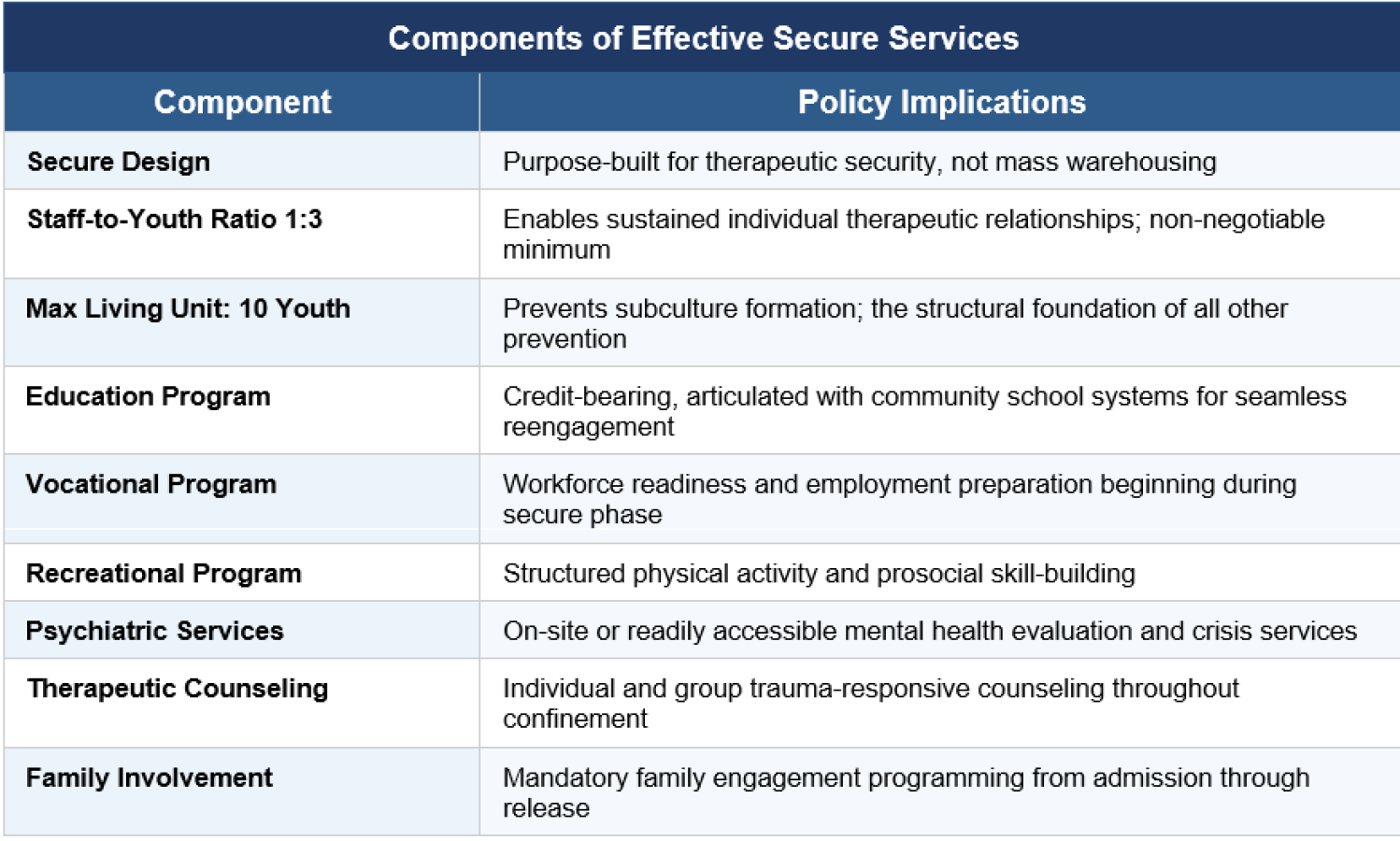
Cultural Prevention: Programming Density and Therapeutic Climate
The programming components in the CJCJ framework: education, vocational training, therapeutic counseling, recreation, and family engagement, do more than deliver services. They fill the institutional day with purposeful activity, reduce the idle time that subcultures exploit, and create prosocial relationships between youth and staff. McEwen’s 1973 Massachusetts research confirmed this directly: highly structured and mandatory programming reduced coercive peer dynamics in large programs compared to large unstructured ones — but did not eliminate them. Youth in large structured programs still reported substantially higher rates of peer coercion than youth in small programs. Programming density is a valuable secondary protection, but not a substitute for the previously discussed 10-youth therapeutic supervision threshold (McEwen, 1978).
The therapeutic climate of a facility is determined primarily by what happens between scheduled programs — in the living unit, during meals, during transitions, during unstructured time. Staff who understand trauma, who know their youth individually, and who respond to behavioral escalation with de-escalation rather than discipline determine whether the facility reinforces or undermines the treatment work. Hiring and training requirements must reflect this reality.
Behavioral Prevention: Conflict Mediation and Individualized Response
Early intervention in developing conflicts before they escalate to violence requires staff who know their youth well enough to recognize early warning signs, and institutional protocols that support de-escalation as the primary response. Counties must implement:
- Restorative justice practices within facilities — structured conflict resolution that addresses harm, rebuilds relationships, and teaches skills youth will need in community settings.
- Mental health crisis protocols that provide immediate, therapeutically appropriate responses to behavioral crises, rather than reflexive isolation or mechanical restraint.
- Formal prohibition of solitary confinement and cell-based isolation as behavioral management tools. Any use of room confinement must be time-limited, clinically supervised, and individually documented and reported.
A note on gang programming: the CYA and DJJ operated specialized gang intervention units within their institutions for decades, employing gang specialists and housing-separation protocols premised on the idea that gang identity could be addressed as a discrete program target. The evidence from that experience is unambiguous, it did not work. Rather than disrupting gang culture, specialized gang programming institutionalized it. Gang-designated housing validated gang identity as the organizing principle of facility life. Gang specialist roles created staff whose professional function depended on the persistence of gang dynamics. Youth who arrived with marginal or situational gang involvement were sorted into gang categories that hardened affiliations rather than loosened them.
This dynamic was identified by Malcolm Klein, the USC criminologist who spent decades as the leading American researcher on street gangs. Klein’s foundational 1969 study of the Group Guidance Project, a large-scale gang intervention applied to approximately 800 youth across four gang clusters, found that the program was associated with a significant increase in gang delinquency. The mechanism was group cohesiveness: gang-focused group programming, by treating youth as gang members rather than as individuals, reinforced the collective identity it was intended to dissolve. The more intensive the group programming, the more cohesive and delinquent the gang became. Klein drew the conclusion that would anchor his career: interventions that target gang members as a group inadvertently strengthen the gang. His later work, including Street Gangs and Street Workers (1971) and The American Street Gang (1995), extended and confirmed this finding across decades of research. The implications for institutional settings are direct. A juvenile facility that organizes its response around gang classifications — through designated housing, specialized staff, or gang-focused group programming — applies exactly the mechanism Klein identified as counterproductive. It treats gang membership as the salient identity and, in doing so, makes it more so (Klein, 1969; Klein, 1971; Klein, 1995). The lesson is not that gang involvement is irrelevant to institutional safety. The lesson is that it cannot be addressed through programs that treat gang membership as the unit of intervention. The correct approach is the one the small-unit model makes possible: treating each young person as an individual, understanding their specific history, relationships, and needs, and addressing those needs directly through the therapeutic and educational program.
A facility that knows its youth as individuals, not as gang classifications, and maintains the structural conditions for genuine supervisory relationships is inherently better positioned to prevent violence than any specialized gang intervention overlay could provide.
Physical Facility Design: Building Environments that Support Treatment
The physical environment of a commitment facility is not a neutral backdrop to treatment programming. It either supports or undermines every therapeutic goal the facility is trying to achieve. California’s DJJ institutions were not designed for rehabilitation, they were designed for mass custodial management. Open dormitories with central guard stations, cavernous common areas, institutional corridors, and the near-total absence of private or quiet space were architectural expressions of a custody-first philosophy. No new construction is required or appropriate: California’s counties already operate 9,113 juvenile hall beds operating at barely 31 percent of capacity, with 6,252 beds sitting empty (BSCC, 2026, 2026a). The task is retrofitting and repurposing a fraction of that existing infrastructure to support therapeutic treatment, not developing more.
The principle is direct: every required element of the therapeutic program must have a dedicated physical space that supports it. A facility that mandates daily schooling but has no on-unit or adjacent classroom will not deliver daily schooling consistently. A facility that requires family therapy but has no private counseling room is not capable of providing the service. A facility that relies on de-escalation as its behavioral management approach but offers only isolation cells as its quiet space will inevitably default to punitive isolation. Design determines practice as surely as policy does. Below design requirements are derived from treatment standards and California commitment facility program requirements
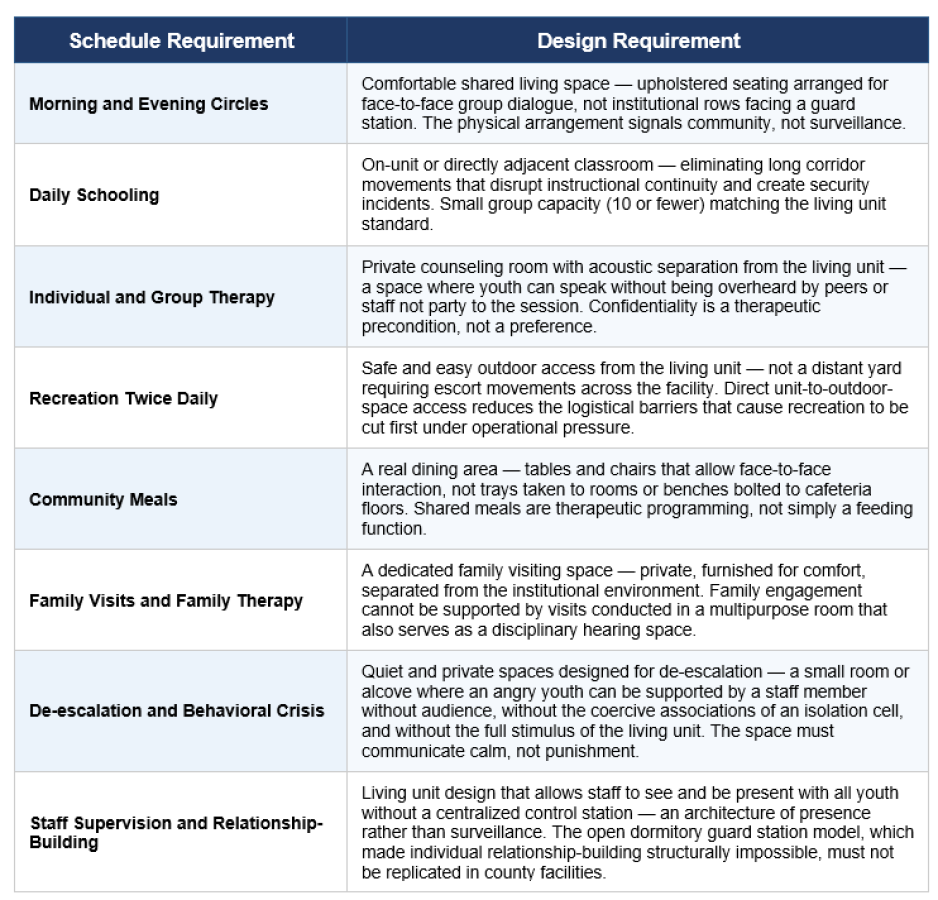
Therapeutic Schedule Requirements and Corresponding Design Standards
Counties undertaking facility renovation or repurposing must apply these standards before work begins and not as an afterthought when programming is already constrained by physical space. The right sequence is: define the therapeutic program, identify the daily schedule each program element requires, derive the physical space each schedule element demands, and renovate accordingly. Counties that reverse this sequence, adapting physical spaces and then designing programs to fit within them, will produce facilities that house committed youth without genuinely treating them. The number of beds a county retrofits for therapeutic commitment should reflect actual population need. Given that most California counties serve very small numbers of youth in the secure track, means a small number of designated units within an existing facility and does not necessitate a facility-wide conversion.
Preventing Staff Abuse and Negligence
The DJJ’s institutional failures included staff misconduct — abuse, negligence, excessive use of force, and the institutional cultures of silence that allowed misconduct to continue unreported and unaddressed. The Farrell litigation documented staff abuse alongside structural conditions. The pattern is inseparable: institutions that lose control of their environment generate staff cultures in which abuse becomes inevitable.
County commitment facilities must prevent this trajectory through every element of the employment lifecycle.
Hiring: Values Before Credentials
- Values screening. Recruitment must actively identify candidates who understand adolescent development, demonstrate empathy and relational capacity, and have demonstrated aptitude for relationship-based work with young people. Law enforcement background should not be a qualification for therapeutic juvenile care and may be a disqualifier.
- Explicit mission alignment at orientation. Every new hire must understand before beginning work that the facility’s mission is youth rehabilitation and community reintegration and not custody, compliance, or punishment. Orientation must make clear that staff are therapeutic partners, not custodians, and that performance evaluation will reflect this.
- Diverse and community-connected workforce. Staff who share cultural backgrounds with committed youth, are connected to the communities from which youth come, and can serve as credible role models are more effective in therapeutic relationships and more resistant to the institutional cultures that normalize abuse.
Training: Ongoing and Non-Negotiable
Training is not a one-time onboarding event. It is an ongoing professional development obligation. Every staff member working with committed youth must complete mandatory training in:
- Trauma-informed care: the relationship between trauma exposure and the behaviors staff will encounter: aggression, emotional dysregulation, dissociation, hypervigilance. Staff who understand trauma respond to it therapeutically rather than punitively.
- De-escalation and crisis intervention: Crisis Prevention Intervention (CPI) or equivalent, mandatory pre-service and annually refreshed. Physical force must be understood as a last resort in genuine safety emergencies, not a routine management tool. All physical use-of-force must be documented and reported on.
- Restorative practices: approaches to conflict that repair relationships and address underlying needs rather than imposing discipline.
- Cultural competency: awareness and skill relevant to the specific cultural, linguistic, and community backgrounds of the youth the facility serves.
Supervision, Use-of-Force Restrictions, and Reporting
Individual staff misconduct rarely occurs in isolation. It occurs within institutional cultures that permit, normalize, or actively suppress reporting. Preventing those cultures requires:
- Mandatory contemporaneous incident reporting. Every use of force, every use of isolation, every youth injury, and every staff-youth conflict must be documented immediately and reported to facility leadership and the independent oversight body. Documentation requirements must be specific, standardized, and non-waivable.
- Use-of-force restrictions. Physical restraint is permitted only to prevent imminent injury to a youth or staff member. Prone restraint, mechanical restraint except in documented medical emergencies, and any technique restricting breathing are prohibited. These are enforceable minimum safety requirements.
- Prohibition of retaliatory practices. Any staff action that denies services, restricts programming, or imposes additional confinement in response to youth complaints or grievances must be treated as grounds for termination.
- Direct supervisory presence in living units. Supervisors must observe staff-youth interactions directly and frequently. Facilities in which supervisors rarely enter living units cannot identify developing misconduct before it escalates.
Independent Reporting and Complaint Mechanisms
Youth in secure facilities are among the most vulnerable populations in the state; they are in custody, without freedom of movement, and dependent on facility staff for every aspect of their lives. Internal reporting mechanisms alone are inadequate:
- Confidential youth complaint mechanisms not controlled or monitored by facility staff (through ombudsperson programs, legal hotlines, or direct access to oversight bodies) through which youth can report abuse or unsafe conditions without fear of retaliation.
- Family notification within 24 hours of any use of force, any serious injury, or any significant change in a youth’s conditions of confinement.
- Independent investigation authority for the external oversight body and not referral to the facility for self-investigation.
- Explicit whistleblower protections for staff who report colleague misconduct, with zero tolerance for retaliation enforced at the facility director level.
Reintegration as the Core Purpose: The Five-Goal Treatment Sequence
The secure track must be organized around reintegration as its defining institutional purpose, from the moment of commitment, through every day of confinement, and into the community after release. This is the operational expression of SB 823’s statutory mandate: secure confinement is authorized as a means of achieving rehabilitation, not as an end in itself.
CJCJ’s five-goal treatment sequence defines what this requires operationally:
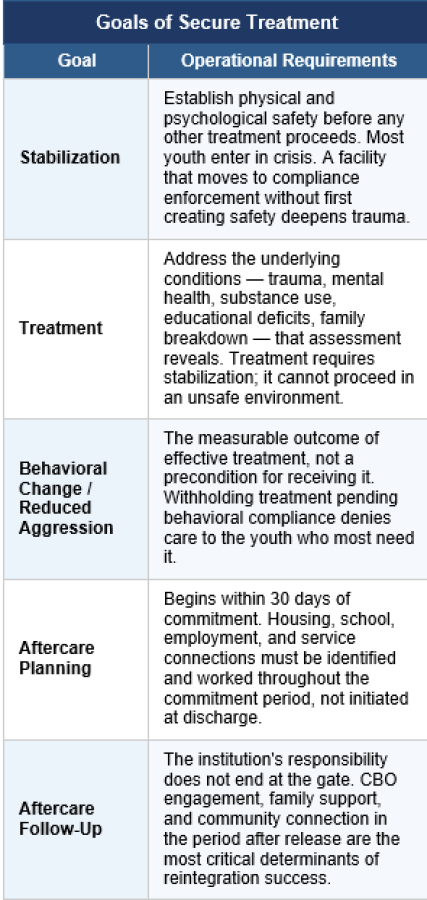
These goals are sequential. Each presupposes the one before it. A facility that provides treatment programming without first achieving stabilization via a physically and psychologically safe environment will not produce behavioral change. A facility that pursues behavioral change without addressing underlying trauma, mental health, and family relationship breakdown will produce compliance, not rehabilitation. And a facility that conducts aftercare planning as a discharge function rather than a treatment function will reproduce the disastrous release failures that drove the DJJ’s horrific recidivism record.
McEwen’s field study of Massachusetts programs documents why this matters. Programs that maintained active family contact and community connections throughout confinement produced measurably better reintegration outcomes than those that isolated youth from family and community. Programs that cut off family contact produced youth who were less connected to their home communities at release. Geographic and relational isolation during confinement undermines reintegration. Family engagement and community connection are active treatment functions, required from the first day of commitment (McEwen, 1978; Labriola et al., 2024).
Reintegration Planning: Operational Requirements
Reintegration planning that begins at commitment and not at the 90-day mark before release requires the following operational commitments:
- Comprehensive individual assessment within 30 days of commitment. Every youth must receive a documented assessment of developmental, educational, mental health, family, and community needs within the first month of commitment. This assessment drives the individual case plan and the reintegration plan.
- A documented reintegration plan for every youth, identifying: home community, family situation, housing arrangement, school or educational program, employment pathway, service providers, and specific barriers requiring active work before release. This plan must be updated regularly throughout confinement and shared with the CBO partners who will sustain it after release.
- Confirmed placements before release. No youth should leave a commitment facility without housing, school enrollment or employment, and service connections confirmed in advance. This is a facility performance standard, not a caseworker’s best effort.
- Shorter confinement as a built-in advantage. Research is consistent: confinement beyond the minimum necessary for stabilization and treatment is inversely related to reintegration success. Counties must resist political and institutional pressures that extend commitment beyond what rehabilitation requires (National Research Council, 2013; Mendel, 2023).
County Continuum of Care
County secure commitment cannot be a terminal disposition. It must be the entry point to a structured continuum of progressively less restrictive settings leading to community reintegration. Most California counties do not currently have this continuum. Developing it is the most operationally demanding challenge of realignment.
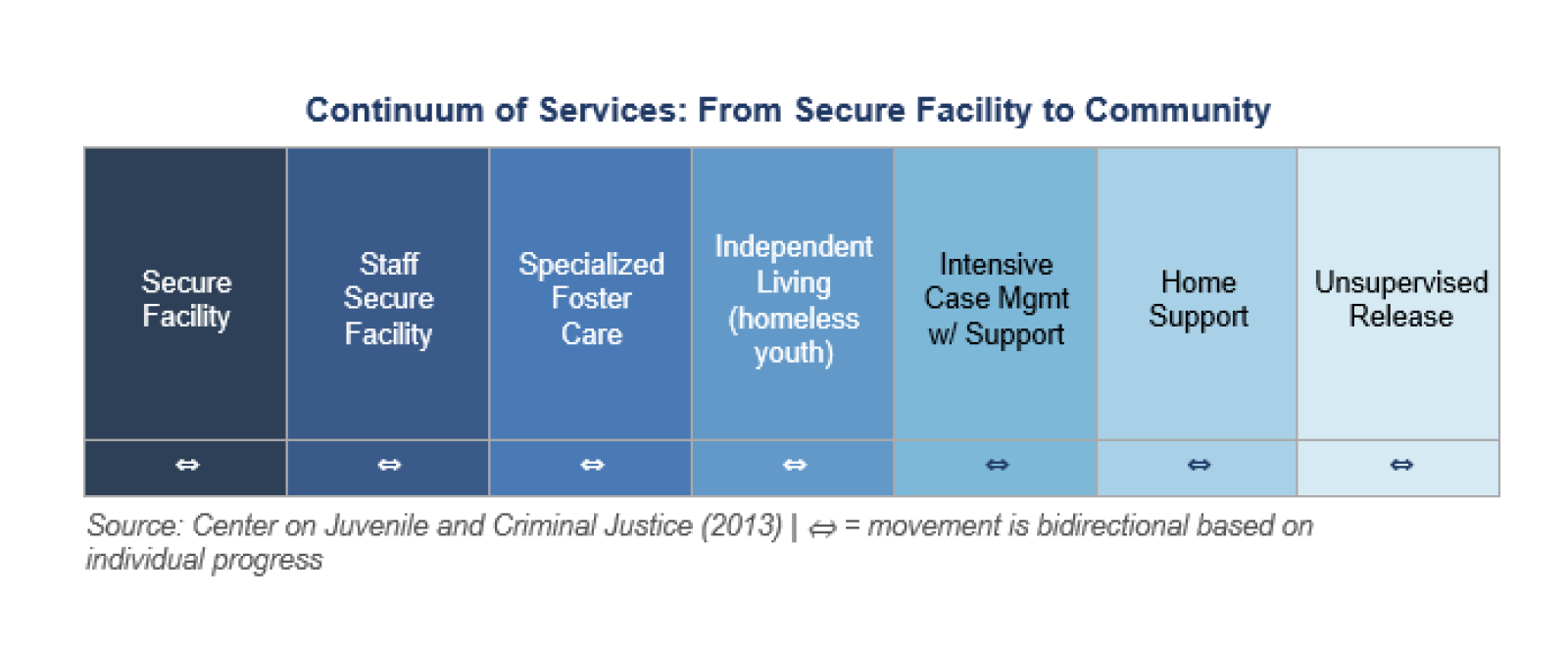
Five decades of research establish why this continuum is an operational necessity. The 1975 Massachusetts cohort study by Coates, Miller, and Ohlin found that youth in secure placements had significantly higher recidivism rates than those in group home, foster care, or nonresidential programs — independent of offense severity or background characteristics (Coates et al., 1977). Youth whose staff actively built community connections such as finding jobs, making school contacts, and linking families, had better long-term outcomes than those in programs providing only encouragement. The Sentencing Project’s 2023 review concluded that confinement “most often results in higher rates of rearrest and reincarceration compared with probation and other community alternatives,” and that longer confinement increases rather than reduces recidivism (Mendel, 2023). The National Academies of Sciences reached the same conclusion, finding that community-based programs outperform institutional confinement “even when applied with relatively high-risk adolescents” (National Research Council, 2013). The continuum from secure commitment to community is the primary variable determining whether youth leave the system with more or fewer connections than they arrived with.
What Most Counties Still Need to Develop
The continuum from secure commitment to community is the primary variable determining whether youth leave the system with more or fewer connections than they arrived with. The intermediate placements in this continuum: staff-secure residential programs, specialized foster care, transitional living, and intensive case management with support funding, are in short supply or nonexistent in most California county systems. Realignment transferred DJJ-eligible populations to counties without creating the intermediate infrastructure those populations require. Counties must actively develop or contract for these placements. Without them, youth will move directly from secure confinement to community supervision with no graduated transition, the same cliff-edge release that produced the DJJ’s worst outcomes.
A critical structural risk must be named directly here. California’s counties entered realignment with a massive surplus of juvenile hall capacity with 9,113 juvenile hall beds operating at barely 31 percent of capacity, with 6,252 beds sitting empty (BSCC, 2026, 2026a). This surplus was not the product of sound planning. It was the product of an early 2000s construction boom that built juvenile halls far beyond what population trends or evidence about effective youth corrections justified. The consequences of that overbuild are still being felt, and realignment creates a new version of the same risk: counties with large numbers of empty beds face institutional and fiscal pressure to fill them. That pressure from staff concerned about positions, from administrators managing fixed facility costs, from officials seeking to justify prior capital expenditures is real and predictable. The response to that pressure must be explicitly resisted in county policy. The size of a county’s secure commitment operation must be determined by the number of youth who genuinely require it which, in most California counties means a small number of designated beds within a single existing facility. The causes and consequences of that overbuild, the political economy of juvenile hall construction, the bond measures and local lobbying that produced capacity far beyond any defensible population projection, and the policy framework required to prevent recurrence, are the subject of Report No. 4 in this series. Counties and the state must not wait for that analysis to act: no new juvenile hall construction should be approved, and existing surplus capacity should be formally decommissioned rather than held available as a reserve against future population pressure that correctional history teaches us facilities will eventually be used to generate.
Key Design Principles
- Bi-directional movement. Youth can and must move to less restrictive settings as they demonstrate progress. When a youth in a less restrictive setting encounters a crisis that temporarily requires more intensive support, they must be able to return without losing their place in the system. Treating regression as disciplinary failure is inconsistent with what is known about adolescent development.
- Accommodation of youth without stable homes. A substantial share of youth released from secure commitment do not have stable, supportive family environments. The continuum must include independent living and intensive case management options for these youth. A reintegration system that addresses only youth with stable families is not a reintegration system.
- Regional collaborative models for small counties. Small and rural counties cannot independently sustain the full continuum. Regional collaborative models, in which neighboring counties pool resources to access shared continuum components, are the only viable path for these jurisdictions. The state must provide the funding and regulatory framework to support them.
Community Based Partnerships: Building the Right Relationships
California has substantial CBO infrastructure with decades of experience serving justice-involved youth. These organizations are essential to realignment’s success. The critical operational question is not whether to partner with CBOs but which organizations to partner with and on what terms.
What Authentic CBO Partnerships Require
A correctional program is community-based to the degree that its staff, clients, and operations are genuinely embedded in the network of relationships — schools, employers, families, civic institutions — of the specific communities from which committed youth come. That network is located in specific neighborhoods, not in county probation offices or regional corporate headquarters. The organizations embedded in those specific communities are the ones that can deliver authentic community-based services.
Effective CBO partnerships in the secure track have four characteristics:
- Presence during commitment, not only after release. CBOs that begin working with committed youth on day one of commitment, maintain contact throughout confinement, and continue the relationship after release provide something no facility-based program can: continuity across the institutional boundary. This continuity is the most important determinant of successful reintegration.
- Family engagement as a core CBO function. CBOs maintain relationships with committed youth’s families throughout confinement, reducing the family disconnection that the DJJ produced through geographic isolation, and building the family stability that reintegration requires.
- Community resource brokering. Effective CBOs actively connect committed youth to housing, school placements, employment, and services in their specific home communities before release. They know which landlords will accept returning youth, which employers will hire them, which schools will readmit them.
- Advocacy where resources are lacking. Where the community resource network is depleted, as it is in many of the high-poverty urban communities that generate serious juvenile justice involvement, effective CBOs advocate for the creation of resources, not just the connection to existing ones.
The Threat of Corporate Service Substitution
The critical distinction is between relationship-based community organizations and program vendors. Coates identified the risk precisely: “placing a halfway house or a group home in the ‘community’ is no guarantee that it will develop any ties with that community. Too many programs are merely islands within the community — small institutions, but institutions nonetheless” (Coates, 1977, p. 24). An organization that delivers sessions inside a facility but has no presence in the youth’s home community, no relationships with their family, and no network of employers or schools is a program vendor, not a community partner. A 2024 RAND expert panel found that juvenile justice systems are “not structured to partner or engage with families as they support their justice-involved youth” a failure that applies equally to facilities and the vendors operating within them (Labriola et al., 2024). Authentic CBOs are embedded in the youth’s home community before, during, and after commitment, actively building the relationships that secure facilities cannot build on their own.
Realignment has created a substantial new funding stream that will attract large private service providers. The risks of contracting primarily with corporate or large nonprofit providers are significant:
- Standardized programming unadapted to specific community contexts. A manualized cognitive-behavioral program administered by a national provider with no local community roots is not community-based corrections, regardless of how the contract is labeled.
- Weak or nonexistent community ties. Corporate providers can deliver sessions inside a facility. They cannot provide the community connection, the family relationships, neighborhood networks, and employer contacts — that makes reintegration work.
- Compliance-driven service cultures. Large providers optimize for contract deliverables, sessions delivered, participants enrolled, forms completed, rather than for the therapeutic relationships and community connections that produce outcomes. The difference between compliance-driven and relationship-driven service is visible in whether youth engagement persists after the formal service period ends.
- Displacement of local CBO capacity. Dollars that flow to large corporate providers do not build local CBO infrastructure. They extract resources from the community service ecosystem that realignment depends on for long-term sustainability.
Protecting CBO Independence
CBOs that are operationally independent from enforcement agencies can engage youth and families in relationships grounded in trust rather than coercion. When that independence is compromised through funding control, reporting requirements, or blurred roles, the therapeutic value of the CBO relationship is undermined and youth disengage.
County policy must codify CBO independence from enforcement functions:
- CBO access to committed youth is a guaranteed right, not a facility-controlled privilege.
- CBO staff are explicitly prohibited from serving as compliance monitors or behavioral reporters.
- CBO program participation is not managed as a behavioral reward that can be withheld.
- Multi-year funding agreements, not annual grants, provide the organizational stability that sustained relationship-based work requires.
County policy must explicitly prohibit contracting with any for-profit organization that operates, manages, or holds a financial interest in any form of secure confinement, staff-secure residential placement, or detention facility (whether juvenile or adult, in California or elsewhere). The financial interests of such organizations are structurally incompatible with the rehabilitation mandate that county commitment exists to fulfill. A company that profits from occupancy in one confinement setting has an institutional incentive to generate referrals to confinement in another. That incentive does not disappear when the organization is contracted to provide services nominally aimed at reducing confinement. It operates silently, shaping intake assessments, placement recommendations, and length-of-stay decisions in ways that are difficult to detect and impossible to fully audit. Counties do not need to document specific misconduct to justify this prohibition. The structural conflict of interest is disqualifying on its face.
Accountability and Oversight
California’s institutional youth corrections history is a history of inadequate accountability. The conditions documented by the Commonweal reports in the 1980s were documented by state bodies for decades before those investigations. The Youth Authority was not unaware of its conditions, it was unaccountable for them.
County commitment facilities require accountability structures that are independent of the agencies they oversee, have genuine enforcement authority, and are grounded in publicly transparent data.
Data Transparency Requirements
Every county commitment facility must collect and publicly report, on a regular and standardized basis, the following data:
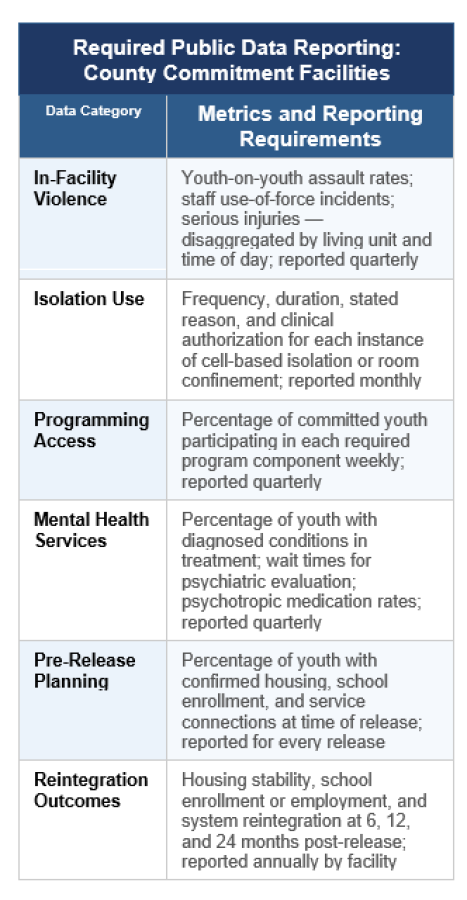
This data must be publicly available in accessible formats, reported to the state legislature and oversight bodies at least annually, and used as the primary basis for accountability decisions about facility funding and operations. Recidivism alone is not an adequate or accurate measure of facility performance, it is too distant from facility operations and too dependent on post-release conditions to meaningfully reflect what happens inside the facility.
The Role of Juvenile Justice Commissions
California law authorizes Juvenile Justice Commissions (JJCs) in each county to inspect juvenile facilities, review conditions of confinement, and report their findings to boards of supervisors. Under the current framework, JJCs are a statutory accountability mechanism that most counties have allowed to atrophy. Realignment creates both the need and the opportunity to revitalize them. A functioning JJC with active membership, meaningful access to facilities, and a direct reporting line to elected officials represents a low-cost, locally grounded layer of oversight that complements state-level. monitoring. The specific governance structure, enforcement authority, and resource requirements for an effective JJC model are substantial enough to warrant dedicated treatment; that analysis is reserved for the accountability report in this series. What this framework requires is that counties not wait for that analysis to act: JJCs should be actively convened, adequately resourced, and given genuine facility access as a baseline condition of county commitment operations.
Independent Inspections
Data reporting is necessary but not sufficient. County commitment facilities must be subject to regular independent physical inspections by entities outside county government. Inspections must include:
- Unannounced visits during all hours of operation including evenings, nights, and weekends, when the conditions that matter most are least visible to administrators.
- Direct confidential interviews with committed youth, conducted without facility staff present, using standardized protocols that allow comparison across facilities and time periods.
- Review of all use-of-force documentation, isolation logs, disciplinary records, and incident reports for the period since the last inspection.
- Physical inspection of living units, programming spaces, medical and mental health facilities, and any isolation or confinement spaces.
- Authority to require corrective action plans with specific timelines, and to escalate non-compliance to the state oversight body with authority to reduce or withhold Juvenile Justice Realignment Block Grant funding.
Youth and Family Feedback
Committed youth and their families are primary sources of information about facility conditions that cannot be captured in administrative data:
- Regular, confidential youth surveys on facility conditions, programming quality, staff treatment, and safety, administered by independent entities, not facility staff.
- Family advisory councils at each facility, with formal input into facility policies and direct access to the oversight body for escalating concerns.
- Youth advocacy programs, through independent organizations or court-appointed counsel — providing committed youth with informed, confidential support in navigating complaint and grievance processes.
- Defense attorneys and public defenders as conditions monitors for their clients. Appointed counsel retains an obligation to their client that does not end at disposition. Attorneys representing youth in committed placements should have guaranteed access to their clients, the ability to inspect conditions relevant to their client’s wellbeing, and a clear channel to report conditions concerns to the oversight body. Public defender offices with active juvenile dockets are among the most reliable early-warning systems for deteriorating facility conditions as they hear directly from clients about what is happening inside, often before administrators acknowledge it. County policy should formalize and support this role rather than treat attorney visits as a security inconvenience.
Performance Review and Improvement
Every county commitment facility must conduct regular, structured reviews of its own performance. Quarterly reviews should examine the facility’s data against its stated goals, identify what is not working and why, produce a written corrective plan with specific timelines and responsible parties, and make those findings available to the public and to the oversight body. CBO partners and family representatives should participate alongside facility administrators, not as a formality, but because they hold information about facility conditions and youth outcomes that internal staff do not. Accountability requires more than identifying failure after the fact. It requires building the management capacity to detect problems early, correct them systematically, and document that correction.
Policy Recommendations
Preventing Institutional Harm
- Cap living unit populations at 10 youth. State standards must establish and enforce a maximum of 10 youth per living unit in all juvenile commitment facilities. This is the structural foundation for all other prevention measures. No county may operate above this threshold.
- Mandate a 1:3 staff-to-youth Ratio. The minimum of one staff member per three youth must be established in all county commitment facilities, with state funding to support compliance.
- Prohibit cell-based isolation as behavioral management. Any use of room confinement must be time-limited, clinically supervised, and individually documented. Solitary confinement as a behavioral management tool is prohibited.
- Require All Nine Program Components as Minimum Infrastructure. Secure design, staffing ratios, living unit limits, education, vocational training, recreation, psychiatric services, therapeutic counseling, and family involvement are required, not optional. Facilities that cannot demonstrate all nine components are not in compliance with their commitment function.
- Establish mandatory pre-service and annual in-service training. Trauma-informed care, de-escalation and crisis intervention, adolescent brain development, restorative practices, and cultural competency training are mandatory for all staff working with committed youth.
- Adopt use-of-force restrictions and independent complaint mechanisms. Physical restraint is limited to genuine safety emergencies. Youth must have access to confidential complaint mechanisms not controlled by facility staff. External oversight bodies must have independent investigation authority.
Reintegration
- Adopt the five-goal treatment sequence as the organizing framework. Stabilization, treatment, behavioral change, aftercare planning, and aftercare follow-up must be the operational framework for individual case planning in every county commitment facility.
- Begin reintegration planning within 30 days of commitment. A documented reintegration plan, covering housing, school or employment, services, family situation, and barriers, must be in place for every committed youth within 30 days of admission and actively worked throughout confinement.
- Confirm placements before release. Housing, school enrollment or employment, and service connections must be confirmed before release. No youth should leave a commitment facility without a complete reintegration plan in place. Pre-release planning completion must be a reported and enforced facility performance metric.
- Mandate a full continuum architecture. Every county must develop or access, individually or through regional collaboratives, the complete continuum from secure commitment through staff-secure residential, specialized foster care, transitional living, intensive case management, and home support.
Community Partnerships
- Guarantee CBO access rights as a formal policy requirement. CBO access to committed youth must be a guaranteed right, not a facility-controlled privilege, codified in county policy and enforced by the oversight body.
- Protect CBO independence from enforcement functions. County contracts must explicitly prohibit CBO staff from compliance monitoring or behavioral reporting. CBO program participation must not be managed as a behavioral reward.
- Prioritize locally rooted CBOs over corporate service providers. County contracting criteria must explicitly favor organizations with genuine community roots, demonstrated cultural competency, and relationship-based service models. Contract evaluation metrics must reflect therapeutic outcomes, not only compliance deliverables.
- Fund multi-year CBO partnerships. Annual grant cycles must be replaced with multi-year agreements that provide organizational stability and allow the relationship continuity that effective reintegration requires. CBO partnerships beginning during commitment must extend at minimum 18 months post-release.
Accountability
- Establish state minimum standards with enforcement authority. The state must establish and enforce minimum standards for all county commitment facilities, covering living unit populations, staffing ratios, program components, use-of-force restrictions, and reporting requirements with funding consequences for non-compliance. The oversight function must be structurally independent: it should be lodged in an entity such as the State Office of the Inspector General, not in organizations with ongoing operational relationships with county probation departments such as the Office of Community and Youth Restoration or the Board of State and Community Corrections.
- Create or empower independent oversight bodies with enforcement authority. This could include a revitalization of Juvenile Justice Commissions (JJC). Independent oversight bodies, with membership including youth with county custody experience, family members, and community advocates, must have authority to conduct unannounced inspections, mandate corrective action, and escalate non-compliance to funding consequences.
- Mandate public data reporting on all six categories. Facilities must publicly report all six data categories in: facility violence, isolation use, programming access, mental health services, pre-release planning completion, and reentry outcomes. Facilities must be evaluated and held accountable on this full range of measures.
- Fund regional collaborative models for small counties. The state must provide funding and regulatory framework for regional collaboratives enabling smaller counties to access the full continuum of placements, specialized programming, and CBO partnerships that no small county can sustain independently.
Conclusion
County juvenile halls did not become commitment facilities by accident. They became commitment facilities by law, specifically, by the mandate of SB 823 and the policy framework of California’s juvenile justice realignment. The operational standards this report specifies are the minimum requirements for fulfilling that legal mandate responsibly.
The DJJ’s structural failures are well documented: scale that made therapeutic supervision impossible, institutional cultures that normalized staff abuse, and release practices that left youth without the community connections reintegration requires. County commitment facilities face identical risks if they inherit those operational patterns. The structural advantages of county systems: smaller populations, proximity to families, local accountability, shorter sentences, are real. They are not self-executing.
California’s counties have the legal framework, the financial resources, and the physical infrastructure that SB 823 created. What the framework demands is operational discipline: capped living units, therapeutic staff cultures, reintegration planning that begins at admission, genuine CBO partnerships grounded in community relationships, and accountability systems with real enforcement authority. Each requirement is specific, demanding, and achievable.
California has documented for too long what happens when youth correctional systems are allowed to operate without proper oversight and enforced standards. The counties that succeed under realignment will be the ones that treat this implementation framework not as an ideal but as a floor.
Selected References
Board of State and Community Corrections (BSCC). (2026). Juvenile Detention Profile Survey Query. At: https://www.bscc.ca.gov/s_fsoj….
Board of State and Community Corrections (BSCC). (2026a). Rated Capacities of Juvenile Detention Facilities. At: https://www.bscc.ca.gov/s_fsoj….
Center on Juvenile and Criminal Justice. (2013). Components of effective secure services; Goals of secure treatment; Living unit populations and institutional subcultures; Continuum of services [Presentation slides]. San Francisco, CA: CJCJ.
Center on Juvenile and Criminal Justice. (2026). Nonprofit community-based organizations: Central partners in service delivery and systems reform. California Juvenile Justice Series, Report No. 1. Daniel Macallair, Executive Director.
Coates, R.B. (1977). Community-based corrections: Concept, impact, dangers. In L.E. Ohlin, A.D. Miller, & R.B. Coates, Juvenile correctional reform in Massachusetts (pp. 23 – 34). National Institute for Juvenile Justice and Delinquency Prevention, U.S. Department of Justice.
Commonweal Research Institute. (1982). Conditions of life in the California Youth Authority. Bolinas, CA: Commonweal.
Commonweal Research Institute. (1986). Bodily harm: The pattern of fear and violence at the California Youth Authority. Bolinas, CA: Commonweal.
DeMuro, P., et al. (1988). Reforming the CYA: How to end crowding, diversify treatment, and protect public safety. Bolinas, CA: Commonweal.
Farrell v. Allen, No. RG 03 – 079344 (Alameda County Superior Court, 2003).
Klein, M.W. (1969). Gang cohesiveness, delinquency, and a street-work program. Journal of Research in Crime and Delinquency, 6(2), 135 – 166.
Klein, M.W. (1971). Street gangs and street workers. Englewood Cliffs, NJ: Prentice Hall.
Klein, M.W. (1995). The American street gang: Its nature, prevalence and control. New York: Oxford University Press.
Macallair, D. (2023). Beyond repair: Envisioning a humane future after 132 years of brutality in California’s youth prisons. Center on Juvenile and Criminal Justice. https://www.cjcj.org/reports‑p…
Feld, B.C. (1977). Neutralizing inmate violence: Juvenile offenders in institutions. Cambridge, MA: Ballinger.
McEwen, C.A. (1978). Designing correctional organizations for youths: Dilemmas of subculture development. Cambridge, MA: Ballinger.
National Research Council. (2013). Reforming juvenile justice: A developmental approach. National Academies Press.
Coates, R.B., Miller, A.D., & Ohlin, L.E. (1977). An exploratory analysis of the recidivism and cohort data. In L.E. Ohlin, A.D. Miller, & R.B. Coates (Eds.), Juvenile correctional reform in Massachusetts (pp. 55 – 80). Washington, DC: U.S. Government Printing Office.
Labriola, M., Peterson, S., Woods, D., Vermeer, M.J.D., & Jackson, B.A. (2024). Community-based alternatives to youth incarceration. RAND Corporation. https://doi.org/10.7249/RR-A10…
Mendel, Richard. (2023). Why youth incarceration fails: An updated review of the evidence. The Sentencing Project.
SB 823 (2020). California Juvenile Justice Realignment. Chapter 337, Statutes of 2020.
California Welfare and Institutions Code § 202; §§ 827 – 828; § 875.
AI Disclosure: This report was prepared with the assistance of AI tools. All analysis, writing, conclusions, and editorial judgments are the author’s own.